Open source visual regression testing tools in 2026
Free, self-hosted open source visual regression testing tools in 2026: Playwright, BackstopJS, reg-suit, Loki, and Lost Pixel, and when to pay for hosted.
 Igor LuchenkovBuilding UI Verify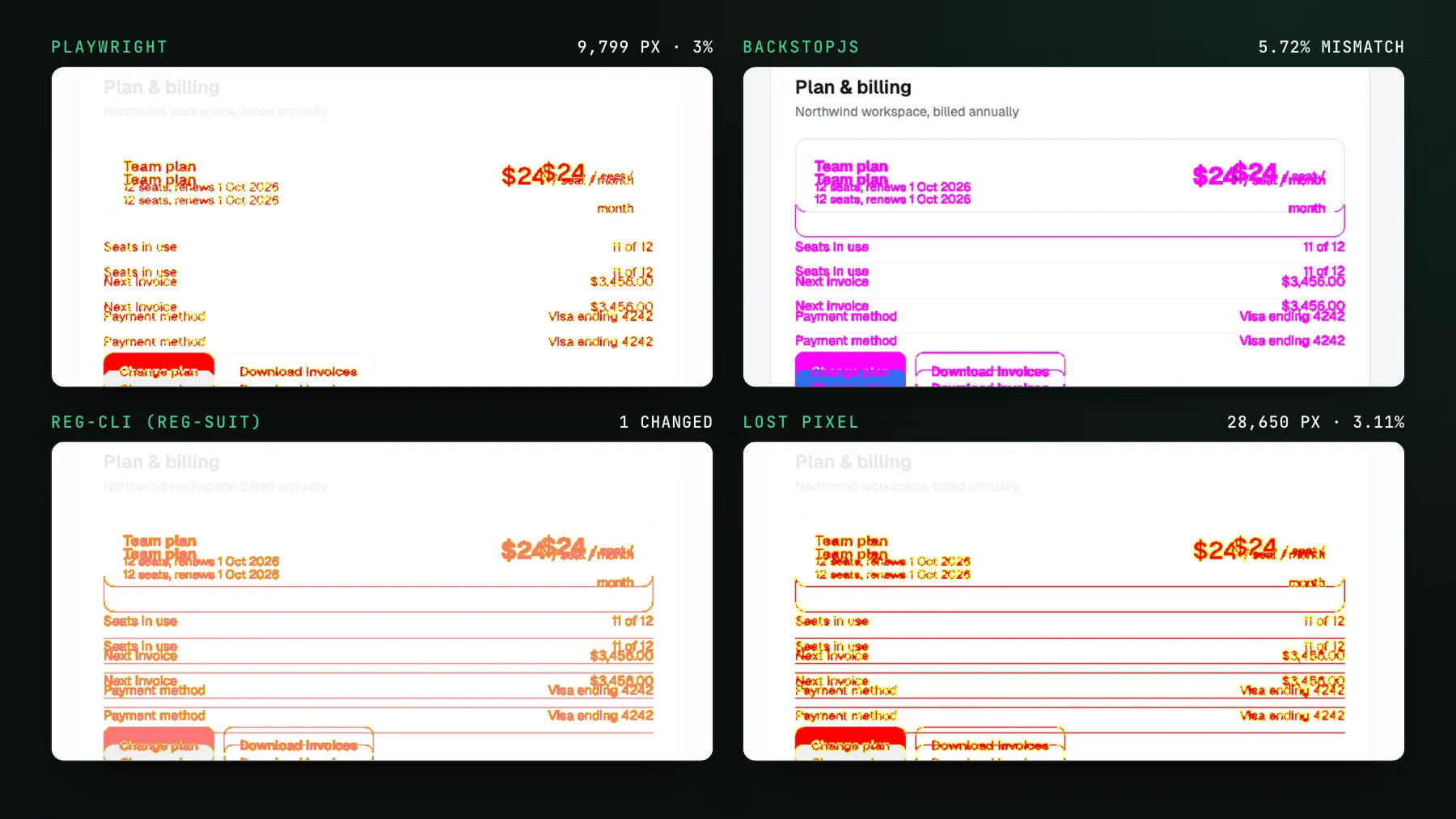
On this page
- What does open source visual testing give you, and what does it not?
- Open source visual regression testing tools, by situation
- Playwright, if your tests already run in Playwright
- BackstopJS, for standalone page-level checks from a config file
- reg-suit, if you already produce screenshots and want to own the pipeline
- Loki, if your components live in Storybook
- Lost Pixel's open-source core, only if an archived dependency is fine
- The diff libraries underneath
- Open source visual regression tools compared
- When a hosted tool is worth paying for
- What is the best open source visual regression tool?
The free, open source visual regression testing tools worth self-hosting in 2026 are Playwright's built-in toHaveScreenshot, BackstopJS, reg-suit, and Loki, with Lost Pixel's open-source core still runnable but archived. Each one captures screenshots of your UI and diffs them against baselines you keep, entirely in your own infrastructure with no per-snapshot cloud bill. They are the right starting point for most teams: free, in your control, and good enough for a long time. This is a shortlist of what each is best at, and the one thing they all leave you to build yourself. For the full category, hosted tools included, see the best visual regression testing tools in 2026.
What does open source visual testing give you, and what does it not?
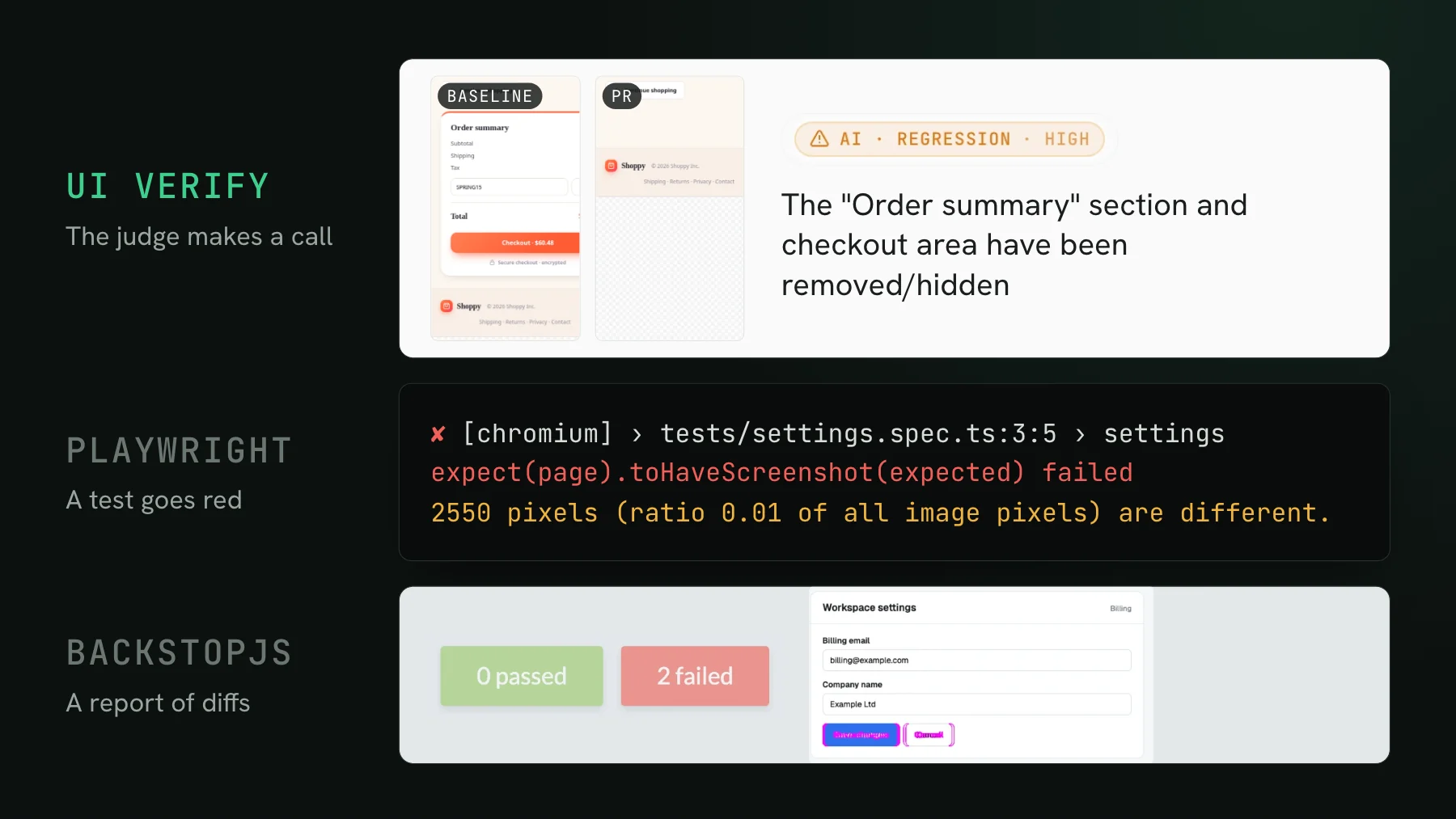
Open source visual testing gives you the capture-and-diff engine for free and leaves the review layer to you, and that trade is always the same. You get the engine and you keep every screenshot in your own pipeline, which is real value. What you do not get is the layer around it: hosted baselines, a review UI to approve or reject a change, history across builds, flake handling, and a verdict on whether a diff is a real regression or an intended change. With an open source tool, a visual change surfaces as a failed test and the judgment is yours. For this post we pushed one CSS change, a price that wraps onto a second line, through Playwright, BackstopJS, reg-cli, and Lost Pixel. All four flagged it, Playwright and Lost Pixel at about 3% of the pixels and BackstopJS at 5.72%, and none of them could say whether the wrap was intended. That is fine at small scale and expensive at large scale, and it is the exact seam hosted tools sell against.
Open source visual regression testing tools, by situation
There is no single winner in this list, so each tool below is matched to the situation it fits. They are judged on how the tool captures, where baselines live, how a change gets reviewed (the three columns of the comparison table at the end), and how much of the pipeline you maintain yourself.
Playwright, if your tests already run in Playwright
Playwright's built-in toHaveScreenshot is the default answer for most teams in 2026. It is already in your test runner, it screenshots a page or element and diffs it against a baseline committed next to the test, and mask, threshold, and maxDiffPixelRatio tame the noise. The catches are the cross-OS baseline problem (a screenshot taken on macOS will not match one taken on your Linux CI, so you generate baselines in a container), baselines living in your repo, and a change arriving as a bare failed assertion with no history or review UI. See toHaveScreenshot or archive-replay and fixing flaky Playwright screenshot tests.
BackstopJS, for standalone page-level checks from a config file
BackstopJS is the long-standing standalone option. It drives Puppeteer or Playwright, captures a configured list of scenarios, diffs them, and generates an HTML report of the differences. It is free, flexible, and self-contained, with scenarios described in a config file rather than in your test code. The trade-off is that you maintain that config and infrastructure, and the report is a local artifact, not a hosted review workflow with approvals and history.
reg-suit, if you already produce screenshots and want to own the pipeline
reg-suit is a capture-agnostic diff-and-report layer. It does not take screenshots itself; you point it at a directory of images your own tooling produced, and it diffs them against a stored baseline set, publishes an HTML report, and can comment on the PR. Baselines live in cloud storage you own, typically an S3 bucket. It pairs well with a capture tool like Storycap for Storybook, and it is a good fit when you want a report and PR comment but want to own the whole pipeline.
Loki, if your components live in Storybook
Loki is Storybook-focused: it captures every story and diffs it against a baseline, running Chrome either through Docker for consistency or locally. If your components already live in Storybook and you want a free way to catch visual changes per story, Loki is a direct fit. As with the others, you own the baselines and there is no hosted review layer. For the hosted end of the Storybook spectrum, see Storybook visual regression testing without Chromatic.
Lost Pixel's open-source core, only if an archived dependency is fine
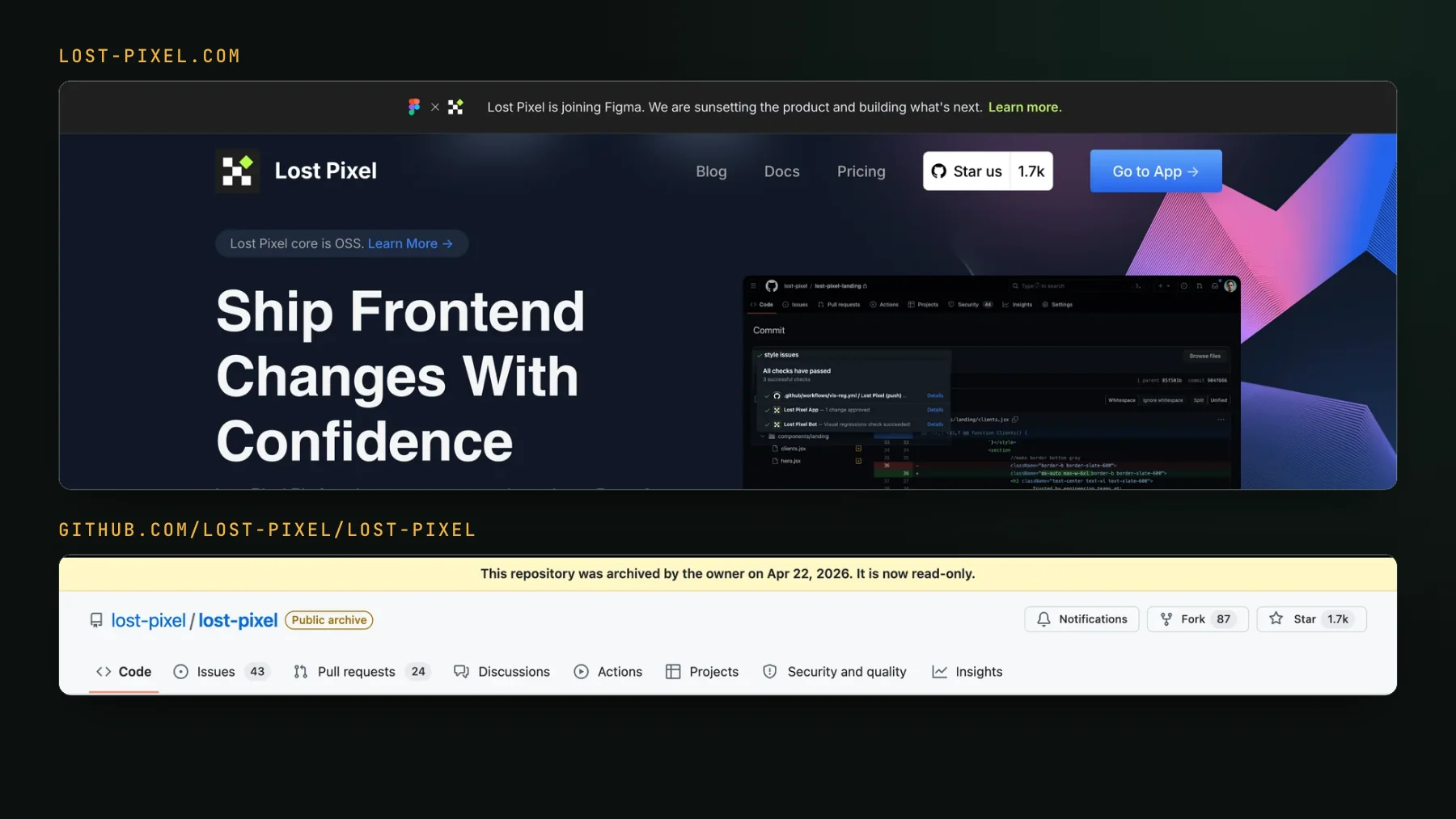
Lost Pixel's open-source core captures Storybook, Ladle, and pages and diffs them in your CI, with baselines in your repo or an S3 bucket. One important caveat in 2026: the Lost Pixel team joined Figma and is sunsetting the hosted platform, and the GitHub repository was archived on April 22, 2026 (still read-only when we checked on 2026-10-17). The OSS core still runs (version 3.22.0 caught our test change), but it is now read-only. Use it if you want its exact model and are comfortable maintaining an unmaintained dependency; if you were on the hosted platform, see the best Lost Pixel alternatives.
The diff libraries underneath
Below the tools sit the primitives, and it is worth knowing them. pixelmatch and Resemble.js are the pixel-comparison libraries most of these tools use internally, and jest-image-snapshot wires pixelmatch into Jest so a screenshot becomes a toMatchImageSnapshot() assertion. If you want the absolute minimum, you can build a homegrown visual check on these directly, but you are then reimplementing baseline management, reporting, and flake handling that the tools above already solved.
Open source visual regression tools compared
| Tool | Capture | Baselines | Review | Best for |
|---|---|---|---|---|
| Playwright | Built in, per test | In your repo | Failed assertion | Teams already on Playwright |
| BackstopJS | Config-driven scenarios | In your repo | Local HTML report | Standalone, page-level checks |
| reg-suit | Bring your own images | Cloud storage you own | HTML report + PR comment | Owning the whole pipeline |
| Loki | Storybook stories | In your repo | Local diff | Free Storybook coverage |
| Lost Pixel (OSS) | Storybook, Ladle, pages | Repo or S3 | Local diff | Its model, now archived |
When a hosted tool is worth paying for
Open source is the right default until the review workload, not the capture, becomes the bottleneck. That happens when the volume of diffs is high enough that a human clicking through failed assertions is the slow step, when flakes have trained the team to rubber-stamp the check, or when coding agents are opening the pull requests and there is no human to triage every screenshot. At that point what a hosted tool sells is the layer open source leaves to you: hosted baselines and history, flake handling at capture time, and a verdict on each change. UI Verify is that layer over the same tests you already run - it replays your Playwright, Storybook, and Vitest suite, the check holds the PR until each change is reviewed, an AI judge classifies each change, and your agent can triage the diffs over MCP. It is free for 10,000 snapshots a month, so you can see whether the review layer is worth it before you pay, and open-source projects get a larger free tier of 50,000 snapshots a month, self-declared at sign-up with no approval and no card (see free for open source). See visual testing, build vs buy for the full trade-off.
What is the best open source visual regression tool?
For most teams it is Playwright, because it is already in your stack and needs no new infrastructure. Choose BackstopJS or reg-suit when you want a standalone, page-level pipeline you fully own, and Loki when your components live in Storybook. All of them are genuinely good, and the honest signal to move to a hosted tool is not that open source stopped working - it is that triaging the results became the job.
Outgrowing your open-source setup?
UI Verify gives an open-source visual suite the parts you end up building by hand: hosted baselines, a review workflow that holds the PR until a change is reviewed, and an AI judge that tells an intended change from a regression. It replays the same Playwright, Storybook, and Vitest tests you already run. Free for 10,000 snapshots a month, or 50,000 for open-source projects.
Start for freeNo credit card required.
Set up visual testing
From no visual tests to a green check on every pull request.