UI Verify vs Chromatic: which one is right for your team?
UI Verify vs Chromatic: same Storybook diffing and skip-unchanged, plus an AI judge on each change, agent review over MCP, and double the free tier.
 Igor LuchenkovBuilding UI Verify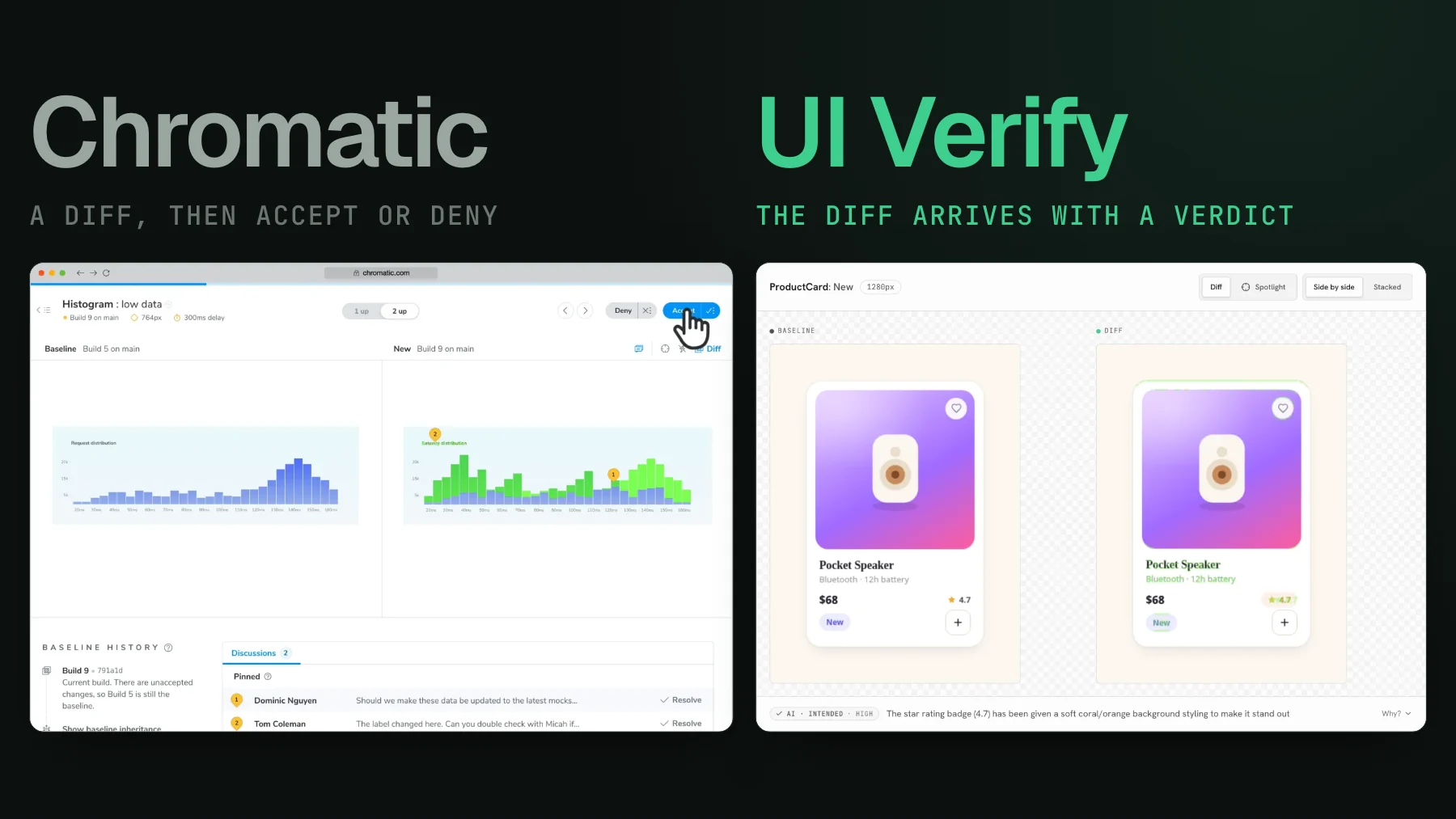
On this page
- What is Chromatic?
- When is Chromatic the right choice?
- When is UI Verify the better fit?
- You want your existing tests to be the tests, whatever the framework
- You want an AI judge on every pull request, not just a diff to approve
- You want agent-native triage over MCP
- What changes when the verdict lands on every pull request
- How do you move from Chromatic to UI Verify?
- If you are comparing more than these two
Chromatic is the better pick if you need axe accessibility checks or Microsoft Edge in the same run; UI Verify is the better pick if you want your existing Storybook, Playwright, and Vitest tests rendered and stabilized for you, with an AI verdict on each change and a review your coding agent can run over MCP. Past those, choosing between UI Verify and Chromatic comes down to two questions: do you want the tool to render and stabilize your existing tests for you, and does your review step hold up when agents are the ones opening pull requests. Both render every state, diff it against a baseline, skip the stories a pull request does not touch, and gate the PR on review, so this is not a teardown. It is an honest read on what Chromatic does well, when it is the right pick, and when UI Verify fits your team better. I build one of the two, so weigh this accordingly. For the point-by-point spec sheet, read UI Verify vs Chromatic first; this post is about the decision, not the feature grid.
What is Chromatic?
Chromatic is the Storybook team's visual testing service: it pioneered Storybook visual testing and is built by the team behind Storybook itself. It renders each of your stories in a real browser, diffs the screenshot against an approved baseline, and runs axe accessibility checks on every plan and Microsoft Edge on its paid tiers (chromatic.com/pricing, checked 2026-10-17), plus a versioned, permalinked Storybook on every build. It reads its own parameters.chromatic config for per-story delay, disabled snapshots, viewports, and modes, and it captures Playwright, Cypress, and Vitest too, so it is not strictly Storybook-only. Being built by the Storybook team makes it a natural default for teams already deep in that ecosystem.
When is Chromatic the right choice?
Chromatic is the better fit when you need axe accessibility checks or Microsoft Edge in the same run as your visual tests, so check those two first, since a switch you do not need is just churn:
- You want accessibility checks in the same run. Chromatic runs axe accessibility checks alongside the visual snapshot, on every plan including the free one. UI Verify does not run accessibility checks.
- You need Microsoft Edge. Chromatic renders Edge on top of Chrome, Firefox, and Safari on its paid tiers; UI Verify renders Storybook stories in Chrome, Firefox, and Safari, and Playwright and Vitest captures in Chrome.
If that list is you, Chromatic is a sound choice and I would not push you off it. Everything else that sends teams looking, though, reduces to the two questions at the top: whether you want your existing tests rendered and stabilized for you, and how the review step holds up when agents are opening the pull requests.
When is UI Verify the better fit?
UI Verify is the better fit when you want your existing tests rendered for you whatever the framework, an AI verdict on each change, or agent triage over MCP. None of the three is a knock on Chromatic as a diff engine. Each is simply a spot where a different design fits a different team better.
You want your existing tests to be the tests, whatever the framework
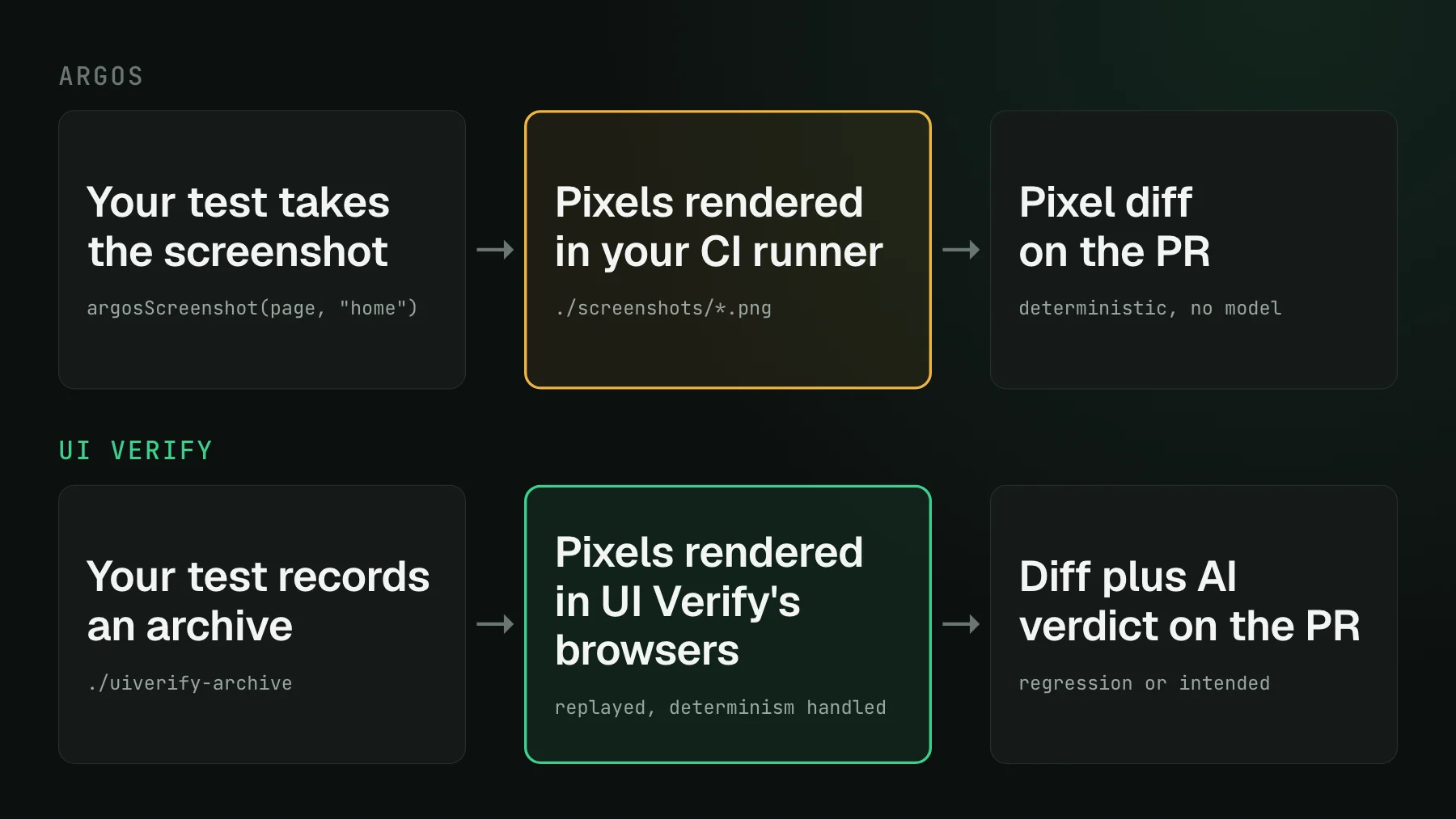
UI Verify captures Storybook stories, Playwright pages, and Vitest browser-mode components by replaying an archive of the run, so the tests you already have are the visual tests, with no separate visual SDK to author and no framework treated as second class. Determinism is handled for you at capture time: a seeded Math.random, cross-origin fonts inlined, images fetched once and cached, a hermetic network, and prefers-reduced-motion, so a re-run does not flake on a font swap or a random layout. Chromatic captures beyond Storybook too, but its center of gravity is the story, and stabilizing a real page or a Vitest component is more your job there. See fix flaky visual tests for what that neutralizes.
You want an AI judge on every pull request, not just a diff to approve
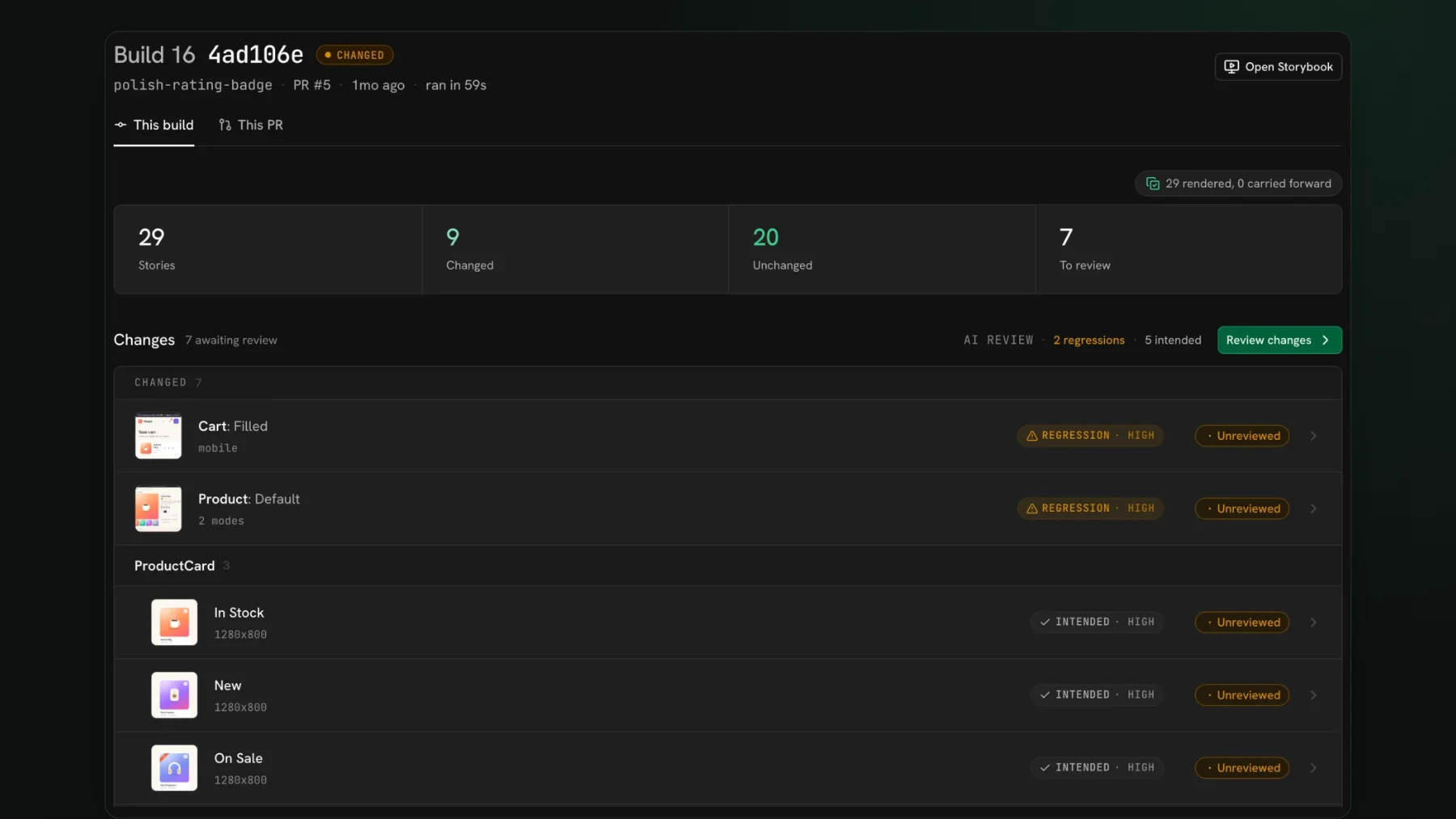
Chromatic posts a deterministic pixel diff and a review queue, and its AI feeds Storybook component context to help you write UI. What UI Verify adds is a verdict on the change itself. UI Verify's AI judge reads each diff against your pull-request intent, labels it a likely regression or an intended change with a reason, and floats a flagged regression to the top of the queue, while the UI Verify check holds the pull request until you review it, so a real break cannot merge behind a green check while everyone is moving fast. Switch the judge on for a project and the verdict lands on every pull request from then on.
You want agent-native triage over MCP
Once the agent that wrote the PR can also review the pixels, review stops being the bottleneck. UI Verify exposes each changed story, its before and after, and the judge's verdict over the Model Context Protocol, so Claude Code or Cursor lists the changes, reads the reasons, and accepts the intended baselines from the terminal, and you step in only for what it flags. Chromatic ships an MCP too, but its AI page (checked 2026-10-17) describes it serving Storybook component context for writing UI; it does not hand over the per-story diffs or accept baselines. There is a walkthrough in triage with your agent, and the triage skill wires the loop into your agent directly.
What changes when the verdict lands on every pull request
Most of the comparison follows from one design choice: does a build hand you a diff to triage, or a verdict already attached to each change. Everything below is downstream of that.
| What you get | UI Verify | Chromatic |
|---|---|---|
| Free tier per month | 10,000 snapshots (50,000 for open source); Chrome, Firefox, Safari for Storybook | Smaller, Chrome only |
| Verdict on each change | AI judge labels regression vs intended; the check holds the PR | Deterministic pixel diff and review queue |
| Agent review over MCP | Reads diffs, accepts baselines | Storybook component context |
| Inherited-change detection | Yes | No |
| Capture model | Archive-replay of Storybook, Playwright, Vitest | Storybook-first, also Playwright, Cypress, Vitest |
| Per-snapshot overage | $0.004 | Higher per snapshot |
How do you move from Chromatic to UI Verify?
Moving is mostly a CI swap, not a rewrite. Your Storybook stories stay exactly as they are, because UI Verify reads the same parameters.chromatic config you already have, disableSnapshot, delay, viewports, and the Modes API, and skips unchanged stories by default. Replace the Chromatic step in your CI with the UI Verify upload step, open a pull request with a uv_proj_ key, and accept the first run to set your baselines. Your Playwright pages and Vitest browser-mode tests come along the same way, since UI Verify replays and renders them for you. The Storybook quickstart gets a visual check on your PRs in a few minutes, no migration required.
If you are comparing more than these two
If you are surveying the whole field rather than only Chromatic, the same two questions apply to Argos, Percy, and Applitools: how the tool captures, and whether the review scales to agent PR volume. They answer those differently, and each now ships its own agent and AI-review flow, so fit is the useful lens rather than one overall winner. See best Chromatic alternatives 2026 for the full roundup and the visual regression testing tools compared page for a side-by-side.
The short answer, UI Verify or Chromatic: keep Chromatic if you need axe accessibility checks or Microsoft Edge in the same run. Switch when you want your existing tests across frameworks rendered and stabilized for you, an AI verdict on every pull request once you turn it on, the PR held until each change is reviewed, and agent triage over MCP. Both render Storybook, publish a permalinked Storybook, skip unchanged stories, have team review where designers comment and approve or reject, and filter flakes, so the tie-breakers are the verdict and the price, not who does Storybook better. The right one depends on which of those you want most.
Switch with a CI swap, keep your stories
UI Verify reads your existing `parameters.chromatic` config and renders your Storybook, Playwright, and Vitest tests for you, can run an AI judge on every pull request to tell an intended change from a regression, and hands the diffs to your agent over MCP. Moving from Chromatic is a CI swap, and the free tier is 10,000 snapshots a month (50,000 for open-source projects).
Start for freeNo credit card required.
Set up visual testing
From no visual tests to a green check on every pull request.