UI Verify vs Argos CI: which one is right for your team?
UI Verify vs Argos CI: which visual regression tool fits your team, weighed on capture, review, and cost. A decision guide, not a spec sheet.
 Igor LuchenkovBuilding UI Verify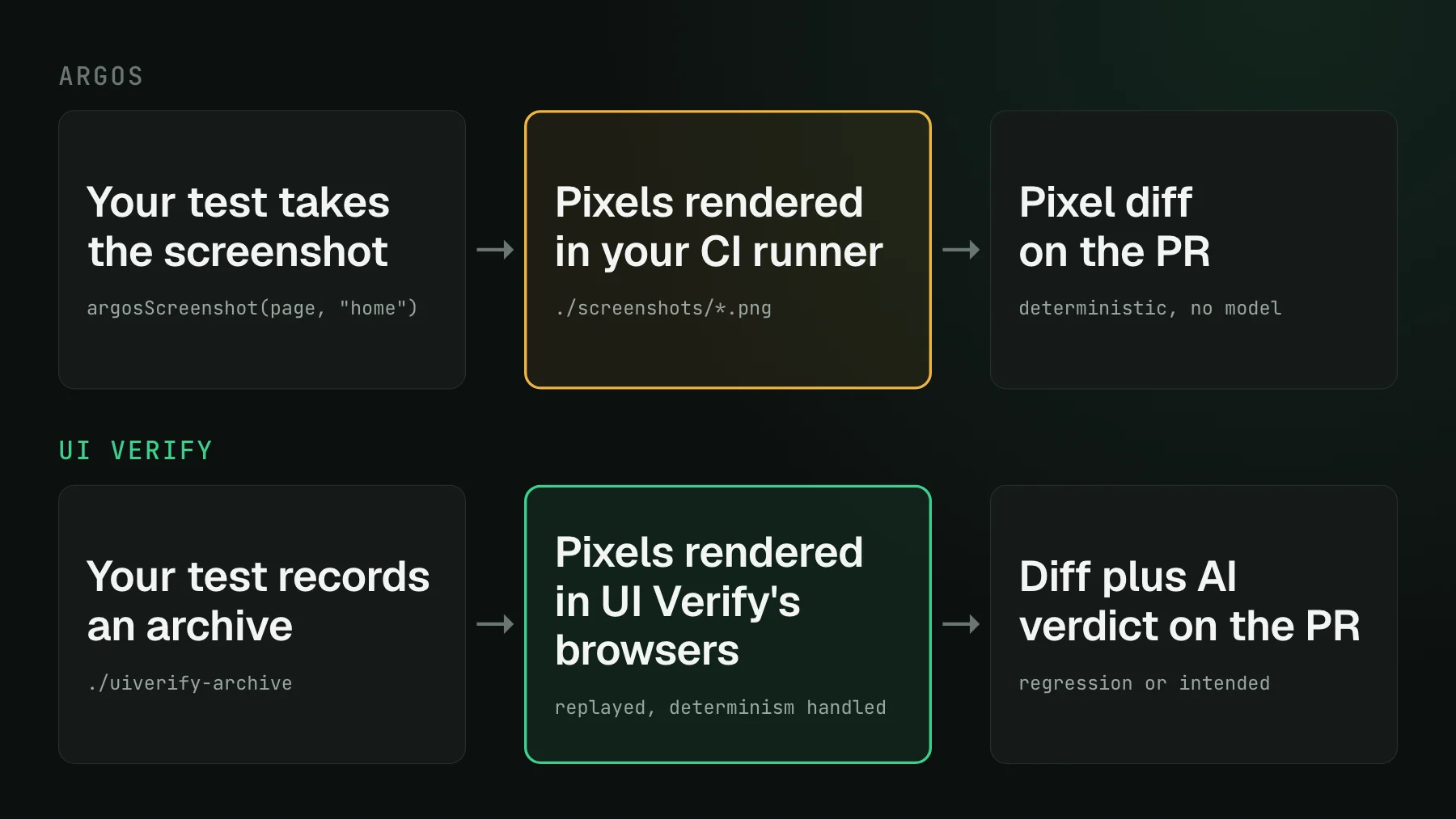
On this page
- Argos CI is an open-source visual testing tool that diffs your CI screenshots
- When Argos is the right choice
- When UI Verify is the better fit
- You do not want to own the capture and determinism pipeline
- You want an AI judge on every build, not only a diff to triage
- You want agent-native triage from the terminal
- What changes when the tool renders instead of ingests
- How to move from Argos to UI Verify
- If you are comparing more than these two
Choosing between UI Verify and Argos CI comes down to two questions: who owns the capture pipeline, and how your review holds up when agents are the ones opening pull requests. Both are solid visual regression tools, so this is not a teardown. It is an honest read on what Argos CI does well, when it is the right pick, and when UI Verify fits your team better. I build one of the two, so weigh this accordingly. For the point-by-point spec sheet, read UI Verify vs Argos first; this post is about the decision, not the feature grid.
Argos CI is an open-source visual testing tool that diffs your CI screenshots
Argos catches visual regressions by comparing each screenshot against an approved baseline and posting the diff on your pull request. The shape that defines everything else is where the screenshots come from: your tests capture them in your own CI, your CI uploads them to Argos, and Argos runs a deterministic pixel diff plus a review flow on top. It works with Playwright, Storybook, Cypress, Vitest, or any pipeline that produces images, and the whole platform including the comparison engine is developed in the open under an MIT license. That last part matters to some teams more than any single feature.
When Argos is the right choice
Start here, because switching for its own sake is just churn. Argos is the better fit when any of these describe you:
- You already capture screenshots in CI and want to keep owning that step. Argos ingests images from any pipeline, including Puppeteer, WebdriverIO, and Cypress setups, so a capture flow you have already tuned drops straight in with nothing to re-architect.
- You want a deterministic pixel diff with no model in the decision. Argos diffs pixel by pixel and does not charge a per-snapshot AI fee, which is the right call if you would rather read the pixels yourself than have anything weigh in on them.
- You value open source. Argos develops its backend, frontend, and screenshot comparison engine in the open under MIT, so you can read the code that decides your builds instead of trusting a closed engine.
- Your suite leans on sharding, retries, or repeat-each. Argos is built to keep parallel and flaky runs consistent, which is real infrastructure work you do not have to redo.
If that list is you, Argos is a sound choice and I would not push you off it. The reasons to look for an alternative are narrower than a listicle would suggest, and they reduce to two questions: who owns the capture pipeline, and how does the review step hold up when agents are the ones opening the pull requests.
When UI Verify is the better fit
Three reasons come up again and again in the conversations I have. None of them is a knock on Argos as a diffing tool. Each is a place where a different design happens to fit a different team better.
You do not want to own the capture and determinism pipeline
Because Argos diffs the screenshots your CI produces, keeping those screenshots stable stays your pipeline's responsibility. Argos ships stabilization helpers, but the render itself still runs in your CI, so the clock, live data, fonts that load a beat late, feature flags, and the exact animation frame are all yours to neutralize. When that work slips, a build goes red on a change nobody made. UI Verify takes the opposite side of that trade: it renders your UI for you by replaying an archive of your existing tests, so the common false-diff sources are handled at capture time, including a seeded Math.random, inlined cross-origin fonts, a fetch-once image cache, a hermetic network, and prefers-reduced-motion. See fix flaky visual tests for what that neutralizes.
You want an AI judge on every build, not only a diff to triage
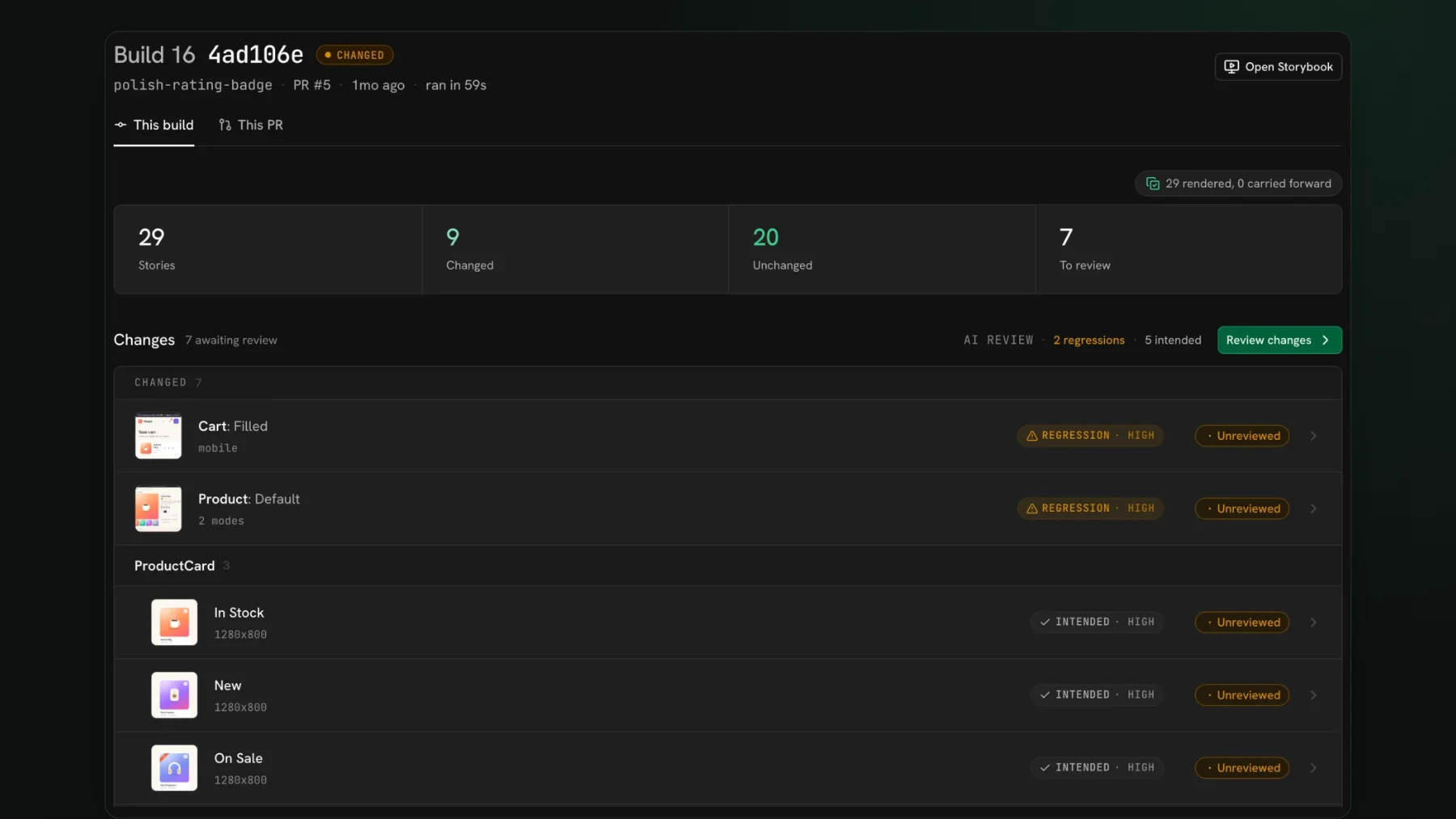
Argos posts a deterministic pixel diff and, through its MCP server and AI-ready review, hands a change to your coding agent so the agent can look at it and land the fix. That agent path is genuinely useful, and both tools ship an MCP for exactly this, so nobody has a monopoly on agent review. The difference is what happens automatically on every build. UI Verify's AI judge reads each change against your pull-request intent, labels it a regression or an intended change, and holds the merge when it flags a regression, so a real break cannot slip past a green check while everyone is moving fast. With Argos the diff is deterministic and the triage is yours or your agent's to initiate; with UI Verify the verdict arrives on the build whether you asked for it or not.
You want agent-native triage from the terminal
When the agent that wrote the PR can also review the pixels, the review step stops being a bottleneck. UI Verify exposes each changed story, its before and after, and the judge's verdict over MCP, so your coding agent lists the changes, reads the reasons, and accepts the intended ones from the terminal, and you step in only for what it flags. There is a walkthrough in triage visual changes from your agent, and the triage skill wires the loop into your agent directly.
What changes when the tool renders instead of ingests
The whole comparison collapses into one mechanical choice: does the tool render your UI, or does it diff the screenshots you produce. Everything below follows from that.
| What you own | UI Verify | Argos |
|---|---|---|
| Screenshot capture | Rendered for you via archive-replay | You capture in CI and upload |
| Keeping renders deterministic | Handled at capture time | Your pipeline, with Argos stabilization helpers |
| Verdict on each change | AI judge labels regression vs intended and holds the PR | Deterministic pixel diff; agent triage over MCP |
| Agent review path | MCP | MCP |
| Source model | Managed service | Open source (MIT), managed hosting |
How to move from Argos to UI Verify
Moving is a CI swap, not a rewrite. Your Storybook stories, Playwright pages, and Vitest browser-mode tests stay exactly as they are, because UI Verify replays them and renders each state for you. Replace the Argos upload step with the UI Verify upload step, open a pull request with a uv_proj_ key, and your baselines build from the first run. Since UI Verify does the rendering, you can also retire the parts of your CI that existed only to capture and stabilize screenshots. The Storybook quickstart and the Playwright quickstart each get a visual check on your PRs in a few minutes.
If you are comparing more than these two
If you are surveying the whole field rather than only Argos, the same two questions apply to Chromatic, Percy, and Applitools: who owns the capture pipeline, and does the review scale to agent PR volume. Each answers them differently, and each has shipped its own agent and AI-review flow, so the useful framing is fit, not a single winner. I wrote up the wider list in best Chromatic alternatives 2026, and the visual regression testing tools compared page lays the field out side by side.
The short answer, UI Verify or Argos CI: keep Argos if you are happy owning capture and want a deterministic, open-source pixel diff. Switch when you would rather the tool render and stabilize for you, and when you want an AI verdict on every build that your agent can triage over MCP. Both are defensible. The right one depends on which of those chores you want to stop doing.
Switch without owning the capture pipeline
UI Verify renders your existing Storybook, Playwright, and Vitest tests for you, runs an AI judge on every build to tell an intended change from a regression, and hands the diffs to your agent over MCP. Moving from Argos is a CI swap, and the free tier is 10,000 snapshots a month.
Start for freeNo credit card required.
Triage a build from your agent
Bucket real regressions vs noise and accept baselines, over MCP.