The best Percy alternatives in 2026
The best Percy alternatives in 2026, compared: UI Verify, Chromatic, Applitools, Argos, and Playwright, with pricing, AI review, and when to leave BrowserStack Percy.
 Igor LuchenkovBuilding UI Verify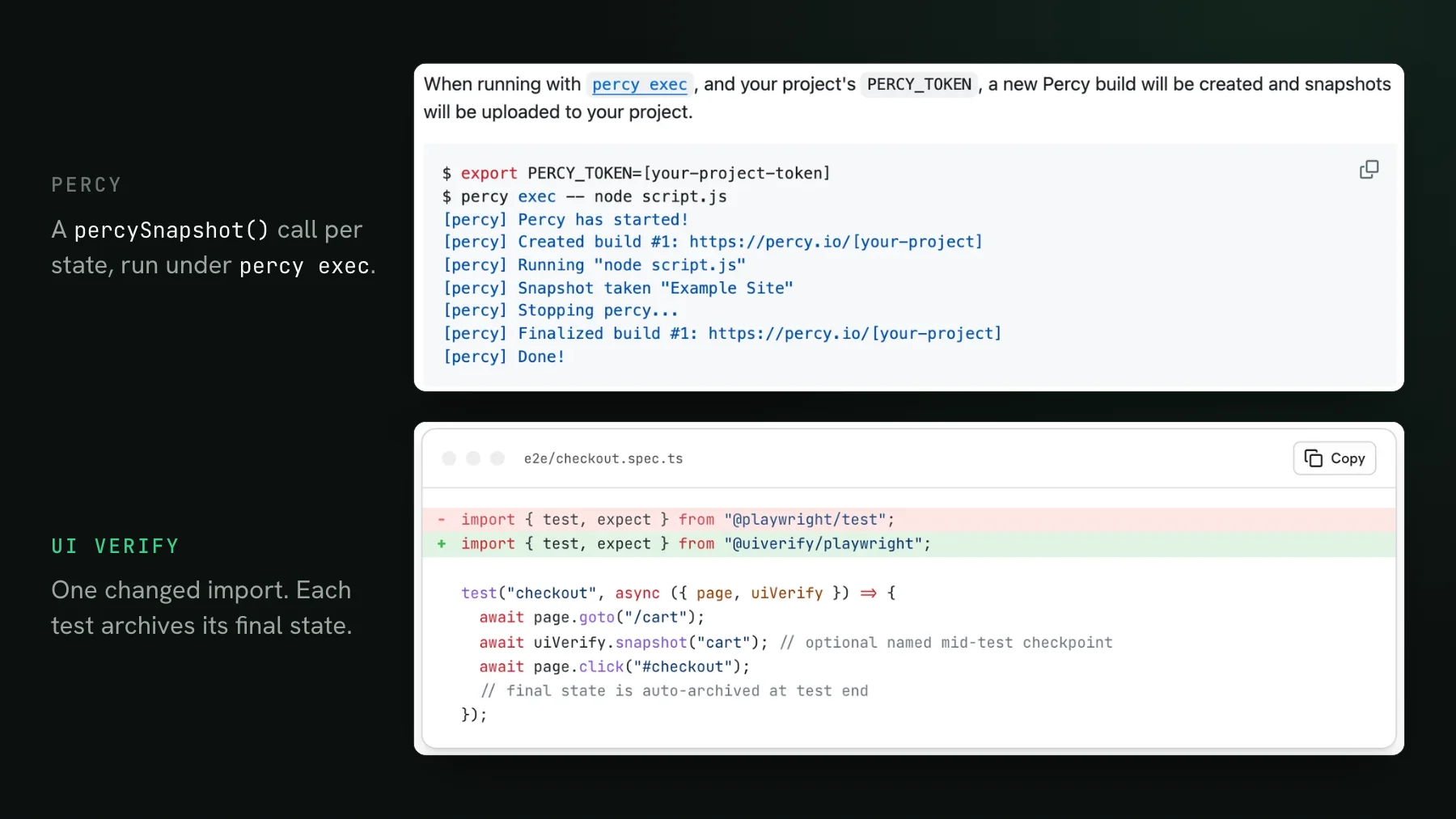
On this page
- Why teams leave Percy
- What to look for in a Percy alternative
- The best Percy alternatives in 2026
- 1. UI Verify: best for agent-written pull requests
- 2. Chromatic: best for accessibility and Microsoft Edge
- 3. Applitools: best for enterprise cross-browser Visual AI
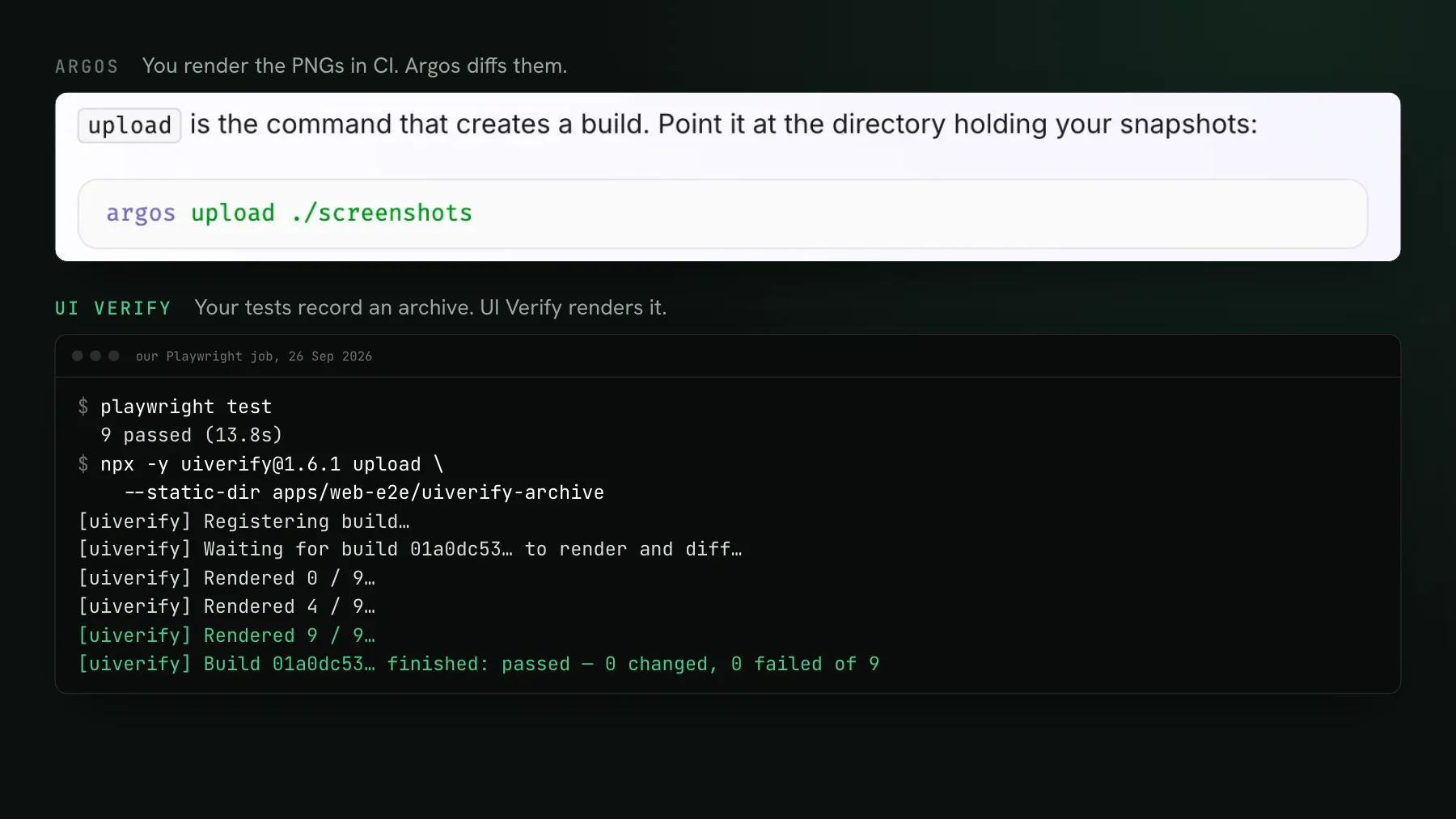
- 4. Argos: best for capturing in your own CI
- 5. Playwright screenshots: best free, local option
- Percy alternatives compared
- When Percy is still the right choice
- What is the best Percy alternative?
Percy is BrowserStack's visual testing product, and it is a capable one. But teams look for a way off it for consistent reasons: it lives inside BrowserStack's billing, you wire it in by sprinkling percySnapshot() calls through your tests, and after the render and the diff it still hands most of the decision back to you. This is a roundup of the real Percy alternatives in 2026, what each is good at, and when you should just stay on Percy.
Why teams leave Percy
The first reason is authoring. Percy wires in through SDK calls, percySnapshot() or percyScreenshot(), added into your test suite, so adopting it and keeping it current is code you write and maintain rather than a capture of tests you already have. The second is that it is one product inside BrowserStack, so pricing, quotas, and the account model come bundled with the wider platform which is a plus if you already live there and friction if you do not. The third is the same shape as every diff tool: Percy's Visual Review Agent labels and summarizes changes, but the review workflow still centers on you working a queue, and at agent-scale PR volume that queue is the bottleneck.
What to look for in a Percy alternative
- Capture that does not mean more code to author. Percy wires in through
percySnapshot()calls you add and maintain; a replay of the Storybook, Playwright, or Vitest tests you already run leaves nothing new to write. - A verdict, not a summarized diff. Percy's Visual Review Agent describes each change, but what saves review time is a tool that decides regression versus intended and holds the merge on a regression.
- Review your agent can drive, an MCP that reads diffs and accepts baselines from the terminal, rather than another web queue to click through.
- A bill you can read on its own, priced for visual testing rather than bundled into a wider BrowserStack account.
- Flake neutralized at capture, so the check earns trust instead of training the team to rubber-stamp it.
The best Percy alternatives in 2026
Five tools worth a look if you are leaving Percy. UI Verify comes first because it is the one I build; every other tool then gets an honest case for when it is the better pick.
1. UI Verify: best for agent-written pull requests
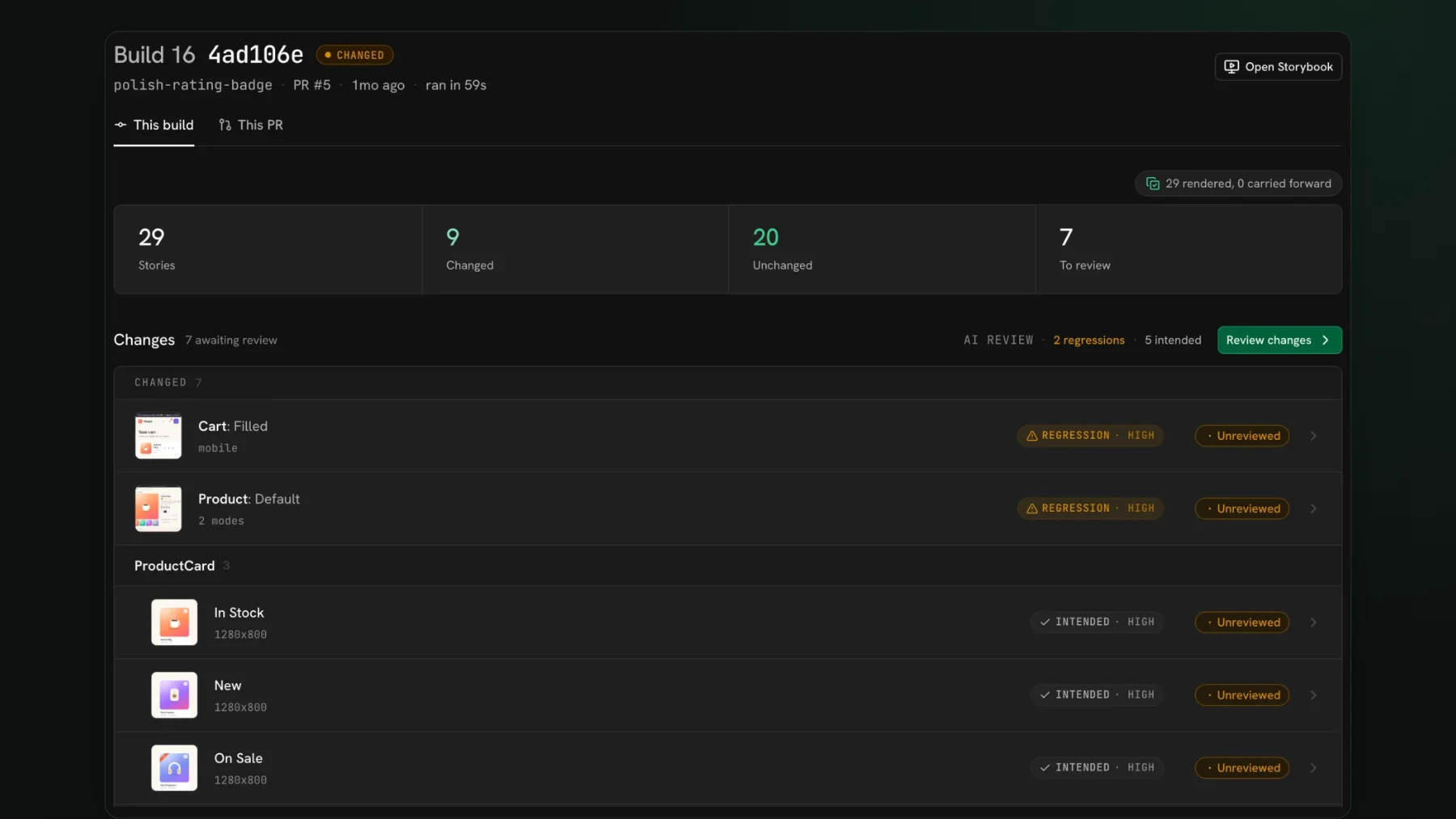
The difference you feel first, moving off Percy, is that there is nothing to author. Percy captures through percySnapshot() and percyScreenshot() calls you add and keep current; UI Verify replays an archive of the Storybook, Playwright, and Vitest tests you already have, so the same suite that runs today becomes your visual suite with no new code in it. On every pull request it screenshots your UI, an AI judge labels each change a regression or an intended change with a reason, and it holds the PR when it finds a regression so a real one cannot merge behind a green check.
- No snapshot calls to write or maintain: archive-replay of your existing Storybook, Playwright, and Vitest tests, in place of
percySnapshot()scattered through the suite. - An AI judge that classifies each change and holds the PR on a regression, so review is decisions, not raw diffs. See the AI judge.
- Agent review over MCP: your coding agent reads the exact per-story diffs and verdicts and accepts the intended baselines from the terminal. See triage with your agent.
- Flake neutralized at capture, not left to your pipeline: Percy renders from the test calls you add, so keeping those stable is on you; UI Verify seeds
Math.random, inlines cross-origin fonts, caches images, cuts the network, and forcesprefers-reduced-motionat capture, then auto-ignores anything a re-render cannot reproduce. - Chrome, Firefox, and Safari on the free tier, at desktop and mobile widths.
To be clear, the AI-review-plus-MCP idea is not ours alone, Percy's Visual Review Agent covers similar ground. Against Percy, the difference is the combination: a judge that blocks the merge, an MCP that accepts baselines, archive-replay so there is nothing to author, and a larger free tier.
Pricing: a free tier of 10,000 snapshots a month, no credit card, then $89 a month for 30,000 snapshots and $0.004 per snapshot beyond, billed on its own rather than folded into a wider BrowserStack account. Open-source projects get a larger free tier of 50,000 snapshots a month, self-declared at sign-up with no approval and no card (see free for open source). See how that compares at your volume in the pricing calculator.
Best for: teams shipping UI through coding agents, and anyone leaving Percy who wants the check to decide regression versus intended rather than hand back a diff.
2. Chromatic: best for accessibility and Microsoft Edge
Chromatic, from the Storybook team, is the pick when you need axe accessibility and Microsoft Edge in the same run. UI Verify renders Storybook too, skips unchanged stories the same way, publishes its own permalinked Storybook, and has design review where designers comment and approve or reject, so the real draw is Chromatic's accessibility and Edge coverage on the paid tiers.
- A mature, designer-facing UI Review, refined over years as the Storybook team's product.
- Accessibility checks with axe and Microsoft Edge on its paid tiers, which UI Verify does not cover.
- Hosted baselines and cloud rendering, billed per snapshot.
Best for: teams that need axe accessibility and Microsoft Edge in the same run. See how the pricing works in Chromatic pricing explained.
3. Applitools: best for enterprise cross-browser Visual AI
Applitools is the enterprise incumbent. Its Visual AI is a perceptual diff engine tuned per checkpoint with match levels, and its Ultrafast Grid renders across many browsers and devices from a single run, with accessibility and design tooling alongside.
- Visual AI with match levels (Exact, Strict, Layout, Dynamic) chosen per checkpoint.
- The Ultrafast Grid: broad cross-browser and device coverage, including Edge and mobile.
- Contrast Advisor for WCAG contrast, plus autonomous test generation.
Best for: large organizations standardizing on one vendor for cross-browser Visual AI and accessibility. See the best Applitools alternatives.
4. Argos: best for capturing in your own CI
Argos is an open-core service that diffs the screenshots your CI captures and uploads, rather than rendering them for you. It has hosted baselines, a review UI, a PR check, and an MCP server for agent-driven triage.
- Hosted baselines and a PR check over screenshots your pipeline produces.
- SDKs for Storybook, Playwright, Puppeteer, and WebdriverIO.
- Open-source roots with a free tier for small projects.
Best for: teams happy to capture screenshots in their own CI who want a lightweight hosted diff layer. See the best Argos alternatives.
5. Playwright screenshots: best free, local option
Playwright ships toHaveScreenshot in the test runner you already use, free and fully local. It diffs a page against a committed baseline image with mask, threshold, and maxDiffPixelRatio for noise control. The catch is ownership: baselines sit in your repo, they do not match across operating systems, and a change is a failed assertion with no history or review layer.
Best for: small, stable suites you would rather review by hand for free than pay to host.
Percy alternatives compared
| Tool | AI review of changes | Capture | Free tier | Best for |
|---|---|---|---|---|
| UI Verify | AI judge, regression vs intended, holds the PR | Archive-replay of your tests | 10,000 snapshots / mo | Agent-written pull requests |
| Percy | Visual Review Agent | SDK calls in your tests | 5,000 screenshots / mo | BrowserStack and device cloud |
| Chromatic | None for diff triage | Storybook-first | 5,000, Chrome only | Accessibility and Edge |
| Applitools | Visual AI, perceptual | Many SDKs | Free trial only | Enterprise cross-browser grid |
| Argos | Agent triage over MCP | You capture in CI, upload | 5,000 screenshots / mo | Capturing in your own pipeline |
| Playwright screenshots | None | Built in, local | Free, local | Small suites you review yourself |
When Percy is still the right choice
Percy wins when you are already on BrowserStack and want your visual testing inside the same account, quotas, and real-device cloud you already pay for. It also wins for native mobile: App Percy covers iOS and Android app visual testing, and Percy runs on BrowserStack's device cloud, so if you need real-device or native-app coverage that is a genuine advantage UI Verify does not match. If neither of those is you, the reasons to leave usually outweigh the reasons to stay.
What is the best Percy alternative?
It depends on your workflow. For teams whose UI is written and reviewed by coding agents, UI Verify fits best because it replays your existing tests, judges each change, and exposes review over MCP. For axe accessibility and Microsoft Edge in the same run, Chromatic. For enterprise cross-browser Visual AI and accessibility, Applitools. If you already capture in your own CI, Argos. And for a free, local option, Playwright's toHaveScreenshot.
Leaving Percy? Try UI Verify
UI Verify screenshots your UI on every pull request and an AI judge tells an intended change from a real regression, then holds the PR on a regression so you review decisions, not diffs. It replays your existing tests instead of asking you to author snapshot calls. Free for 10,000 snapshots a month.
Start for freeNo credit card required.
Set up visual testing
From no visual tests to a green check on every pull request.