The best Applitools alternatives in 2026
The best Applitools alternatives in 2026, compared: UI Verify, Chromatic, Percy, Argos, and Playwright, with pricing, AI review, and when enterprise Visual AI still wins.
 Igor LuchenkovBuilding UI Verify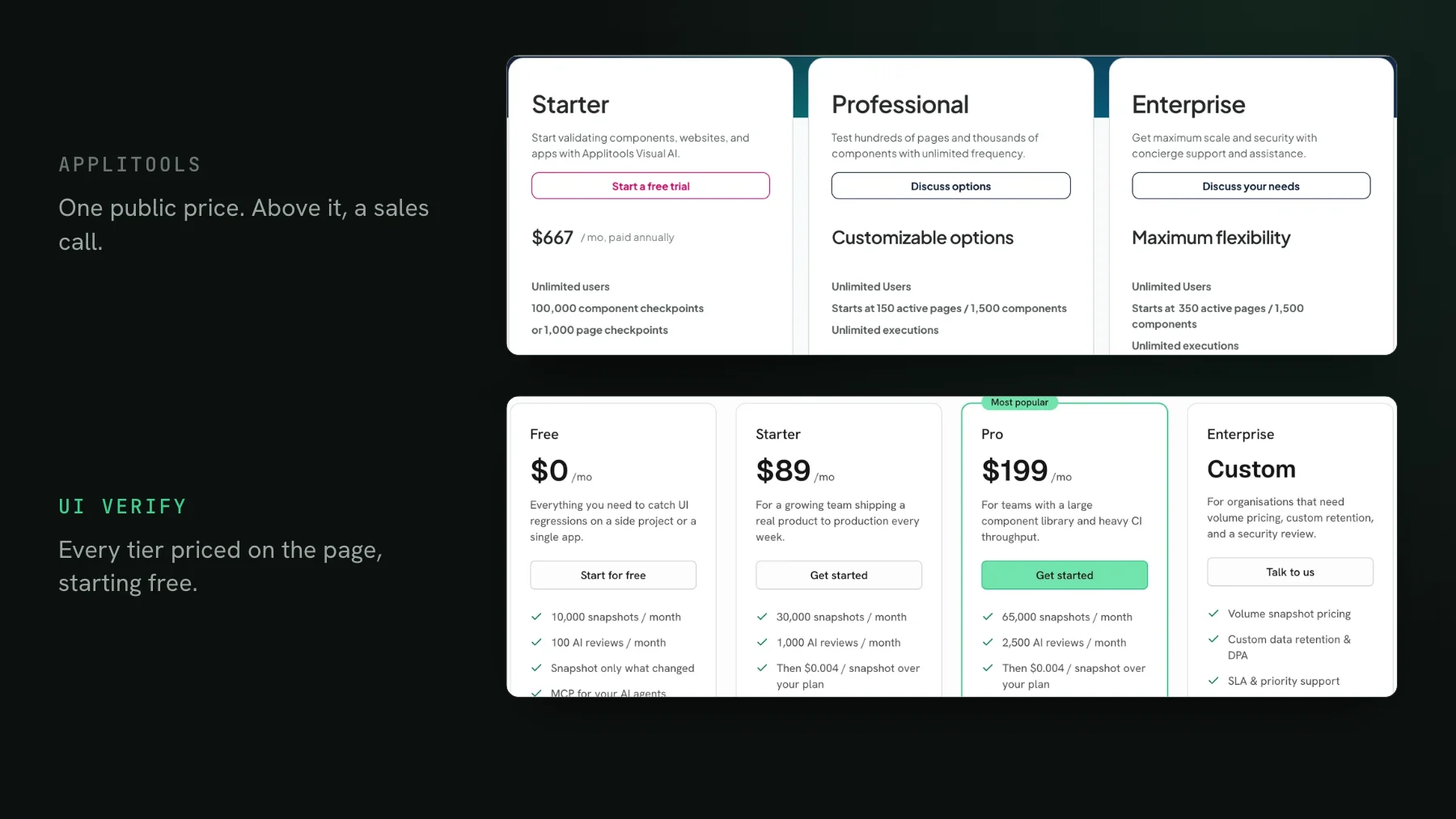
On this page
- Why teams look for an Applitools alternative
- What to look for in an Applitools alternative
- The best Applitools alternatives in 2026
- 1. UI Verify: best for agent-written pull requests
- 2. Chromatic: best for accessibility and Microsoft Edge
- 3. Percy: best for BrowserStack and device-cloud teams
- 4. Argos: best for capturing in your own CI
- 5. Playwright screenshots: best free, local option
- Applitools alternatives compared
- When Applitools is still the right choice
- What is the best Applitools alternative?
Applitools is the enterprise incumbent in visual testing, and its Visual AI is genuinely strong. But plenty of teams look for an alternative for the same reasons: it is sales-led and priced by quote rather than self-serve, its match-level tuning and broad platform are more than many teams need, and getting started is a procurement conversation rather than a CI change. This is a roundup of the real Applitools alternatives in 2026, what each is good at, and when Applitools is still the right call.
Why teams look for an Applitools alternative
The first reason is commercial: Applitools is enterprise and sales-led, with one public entry tier and a quote for everything above it, so a small or mid-market team cannot simply sign up and see the bill. The second is weight: match levels, the Ultrafast Grid, autonomous test generation, and accessibility tooling are powerful, but a team that just wants a visual check on its pull requests is buying and configuring a lot of platform to get there. The third is the modern one: if coding agents open your pull requests, you want review the agent can drive from the terminal. Applitools' MCP server covers setup, inspection, and resolution: it can explain a failed checkpoint and accept or reject it once you approve. It works on Eyes checkpoints, though, so the Eyes SDK and its match levels come first.
What to look for in an Applitools alternative
- Self-serve with a public price, so you evaluate on your own codebase without a sales cycle or a per-checkpoint match-level setup.
- A verdict shaped for PR review, regression versus intended with the merge held, rather than perceptual match levels you calibrate checkpoint by checkpoint.
- An MCP your agent reviews from, reading diffs and accepting baselines in the terminal without an SDK to wire into every test first.
- Capture with no platform to stand up, a replay of the tests you already run instead of a broad SDK integration.
- Flake handled for you, so the check stays trusted without threshold tuning.
The best Applitools alternatives in 2026
Five tools worth evaluating against Applitools. I have put UI Verify first because I build it, then made the honest case for when each of the others is the stronger fit.
1. UI Verify: best for agent-written pull requests
Where Applitools is a platform you configure and a price you request, UI Verify is sign up, point it at your tests, and see the bill. It screenshots your UI on every pull request and an AI judge labels each change a regression or an intended change with a reason, then holds the PR on a regression. Instead of calibrating perceptual match levels per checkpoint, the judge answers the one question a reviewer actually has: was this change the point of the pull request, or a bug that slipped in? Capture is a replay of the Storybook, Playwright, and Vitest tests you already have, so there is no SDK integration to stand up.
- A judge shaped for PR review: regression versus intended, with a reason, holding the merge, rather than match levels tuned per checkpoint. See the AI judge.
- Agent review over MCP that reads each story's diff and verdict and accepts baselines from the terminal, with no SDK calls in your tests. See triage with your agent.
- Self-serve, with a public per-snapshot rate and a free tier, so you evaluate on your own codebase without a sales call.
- Archive-replay of the tests you already have, with no separate visual SDK to author.
- Flake handled without threshold tuning: instead of calibrating match levels checkpoint by checkpoint, UI Verify removes the usual false-diff sources at capture, a seeded
Math.random, inlined fonts, a fetch-once image cache, a hermetic network, andprefers-reduced-motion, and auto-ignores flakes on a re-render.
To be clear, AI review of changes is not ours alone, Applitools' Visual AI is a mature perceptual engine. The case for UI Verify against Applitools is fit: a self-serve product with a judge shaped for PR review and an MCP that accepts baselines, rather than an enterprise platform you configure per checkpoint.
Pricing: a public, self-serve price you can see before you commit, not a quote, a free tier of 10,000 snapshots a month with no credit card, then $89 a month for 30,000 snapshots and $0.004 per snapshot beyond. Open-source projects get a larger free tier of 50,000 snapshots a month, self-declared at sign-up with no approval and no card (see free for open source). See how that compares at your volume in the pricing calculator.
Best for: teams whose UI is increasingly written and reviewed by coding agents, and anyone who wants a self-serve check that makes a call.
2. Chromatic: best for accessibility and Microsoft Edge
Chromatic, from the Storybook team, pairs cloud-rendered stories with axe accessibility checks in the same run and Microsoft Edge on its paid tiers, plus a mature designer-facing UI Review. UI Verify renders Storybook too, skips unchanged stories the same way, publishes its own permalinked Storybook, and has design review where designers comment and approve or reject, so the draw here is accessibility and Edge, not the capture, a published Storybook, or sign-off. It is self-serve and priced per snapshot, a much lighter lift than Applitools.
Best for: teams that need axe accessibility and Microsoft Edge in the same run. See Chromatic pricing explained.
3. Percy: best for BrowserStack and device-cloud teams
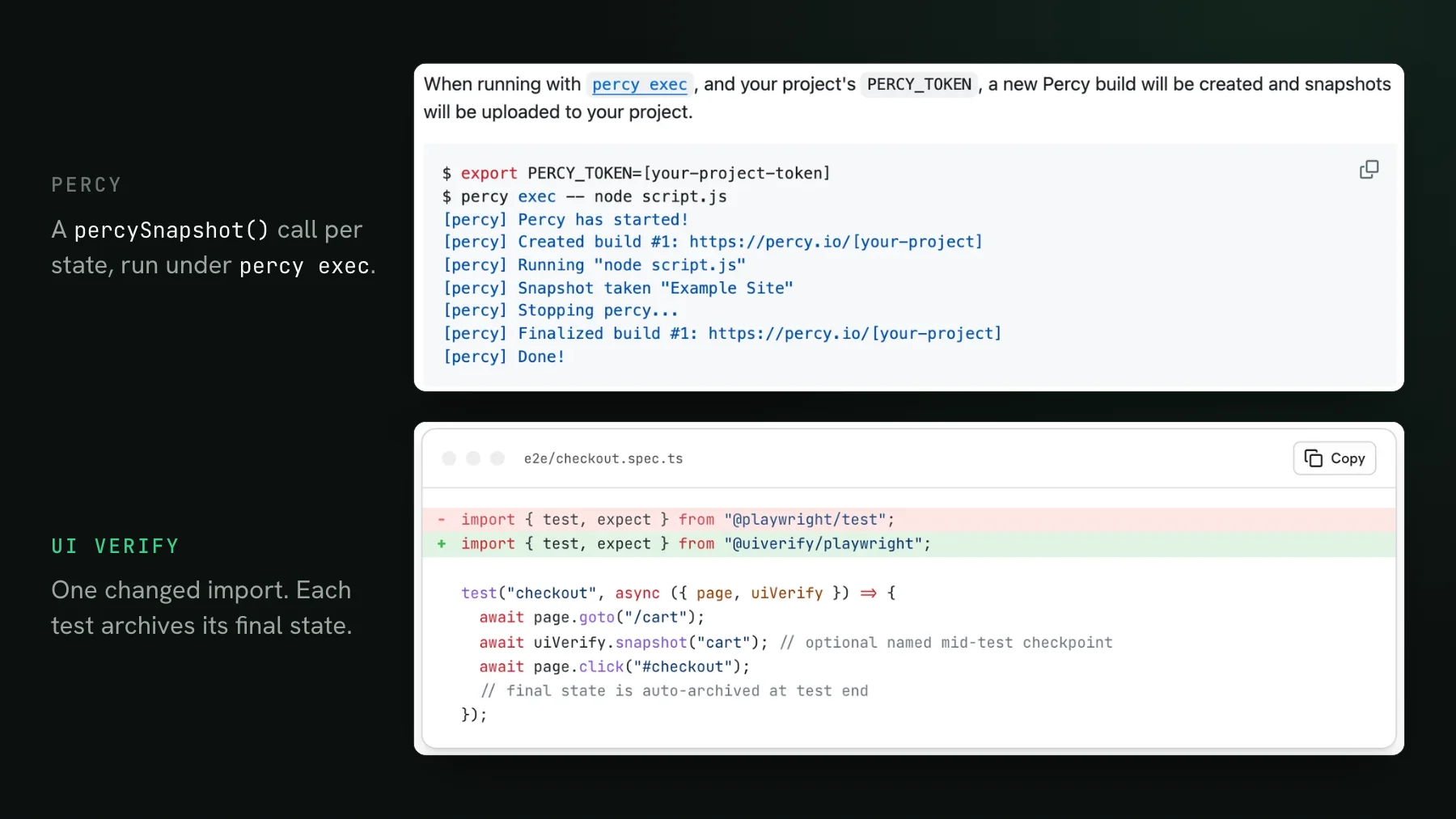
Percy is BrowserStack's visual testing product: real-browser screenshots diffed against hosted baselines with a PR check, a Visual Review Agent that classifies each change, and App Percy for native iOS and Android. If you already run on BrowserStack or need real-device coverage, it is a natural fit.
Best for: teams already on BrowserStack, or anyone who needs native mobile and real-device coverage. See the best Percy alternatives.
4. Argos: best for capturing in your own CI
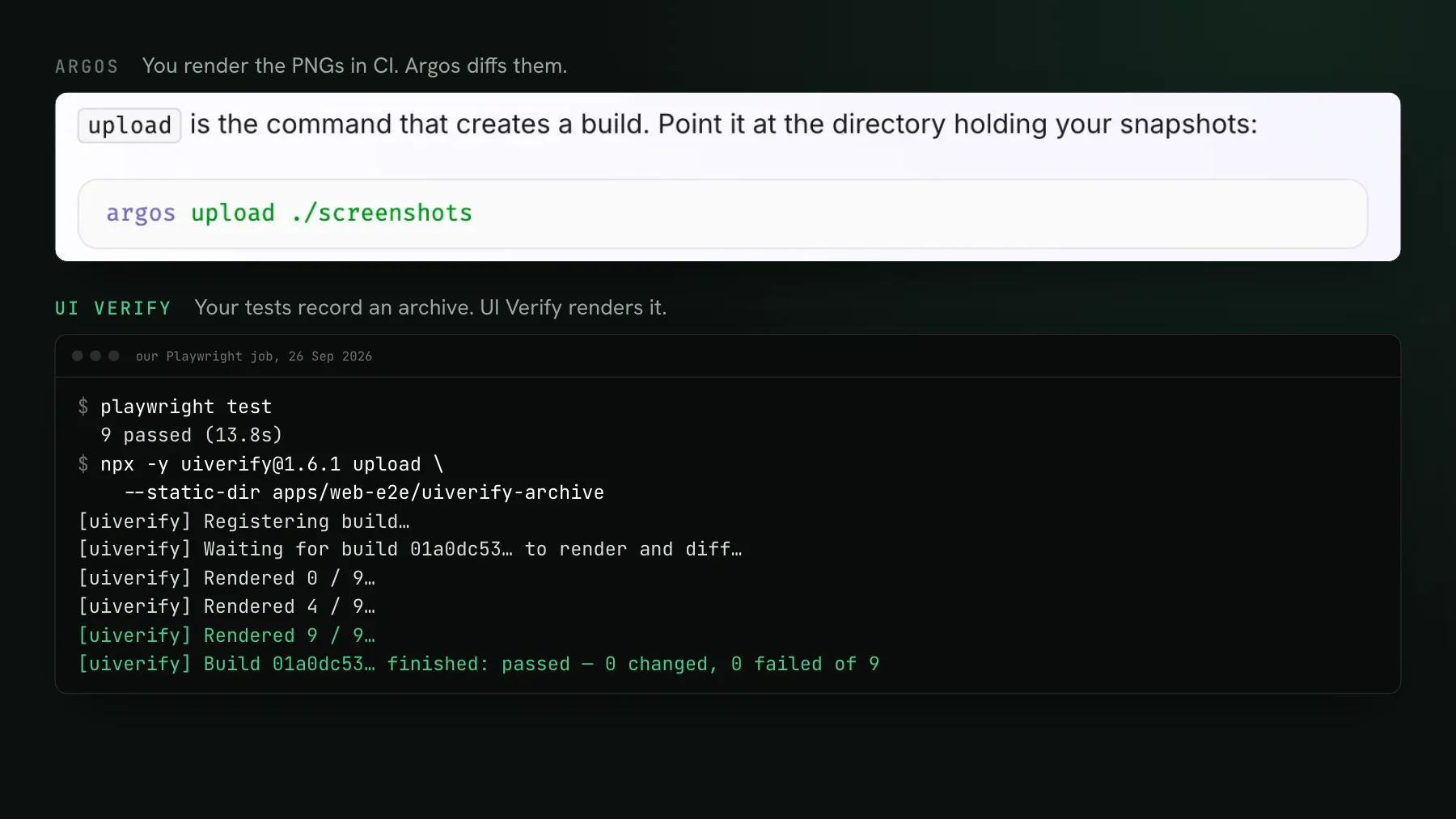
Argos is an open-core service that diffs the screenshots your CI captures and uploads, rather than rendering them for you, with hosted baselines, a review UI, a PR check, and an MCP server for agent triage. It is a lightweight, self-serve hosted layer if you are happy owning the capture.
Best for: teams happy to capture in their own CI. See the best Argos alternatives.
5. Playwright screenshots: best free, local option
Playwright's built-in toHaveScreenshot is free, local, and already in your test runner, with mask, threshold, and maxDiffPixelRatio to tame noise. You trade managed convenience, history, and judgment for a check that lives entirely inside your own CI at no dollar cost.
Best for: small suites you are happy to review yourself.
Applitools alternatives compared
| Tool | AI review of changes | Pricing model | Free tier | Best for |
|---|---|---|---|---|
| UI Verify | AI judge, regression vs intended, holds the PR | Self-serve, per snapshot | 10,000 snapshots / mo | Agent-written pull requests |
| Applitools | Visual AI, perceptual | Enterprise, sales-led quote | Free trial only | Enterprise cross-browser grid |
| Chromatic | None for diff triage | Self-serve, per snapshot | 5,000, Chrome only | Accessibility and Edge |
| Percy | Visual Review Agent | Inside BrowserStack billing | 5,000 screenshots / mo | BrowserStack and device cloud |
| Argos | Agent triage over MCP | Self-serve, per screenshot | 5,000 screenshots / mo | Capturing in your own pipeline |
| Playwright screenshots | None | Free, local | Free, local | Small suites you review yourself |
When Applitools is still the right choice
Applitools wins when you are a large organization standardizing on one vendor for cross-browser Visual AI. Its Ultrafast Grid renders across a wide matrix of browsers and devices, including Edge, from a single run, its match levels give fine perceptual control per checkpoint, and its Contrast Advisor, autonomous test generation, and a plugin that compares designs from inside Figma cover ground UI Verify does not. If you need that breadth under one enterprise contract with dedicated support, Applitools is a legitimate choice and the alternatives here will feel narrower.
What is the best Applitools alternative?
It depends on your workflow. For teams whose UI is written and reviewed by coding agents and who want a self-serve check, UI Verify fits best because it judges each change and exposes review over MCP; for the direct head-to-head, see UI Verify vs Applitools. For a Storybook design system, Chromatic. If you live in BrowserStack or need native mobile, Percy. If you already capture in your own CI, Argos. And for a free, local option, Playwright's toHaveScreenshot.
Leaving Applitools? Try UI Verify
UI Verify screenshots your UI on every pull request and an AI judge tells an intended change from a real regression, then holds the PR on a regression so you review decisions, not diffs. Self-serve, a public price, and a free tier of 10,000 snapshots a month.
Start for freeNo credit card required.
Set up visual testing
From no visual tests to a green check on every pull request.