The best Argos alternatives in 2026
The best Argos CI alternatives in 2026, compared: UI Verify, Chromatic, Percy, Applitools, and Playwright, with pricing, AI review, and when upload-and-diff still wins.
 Igor LuchenkovBuilding UI Verify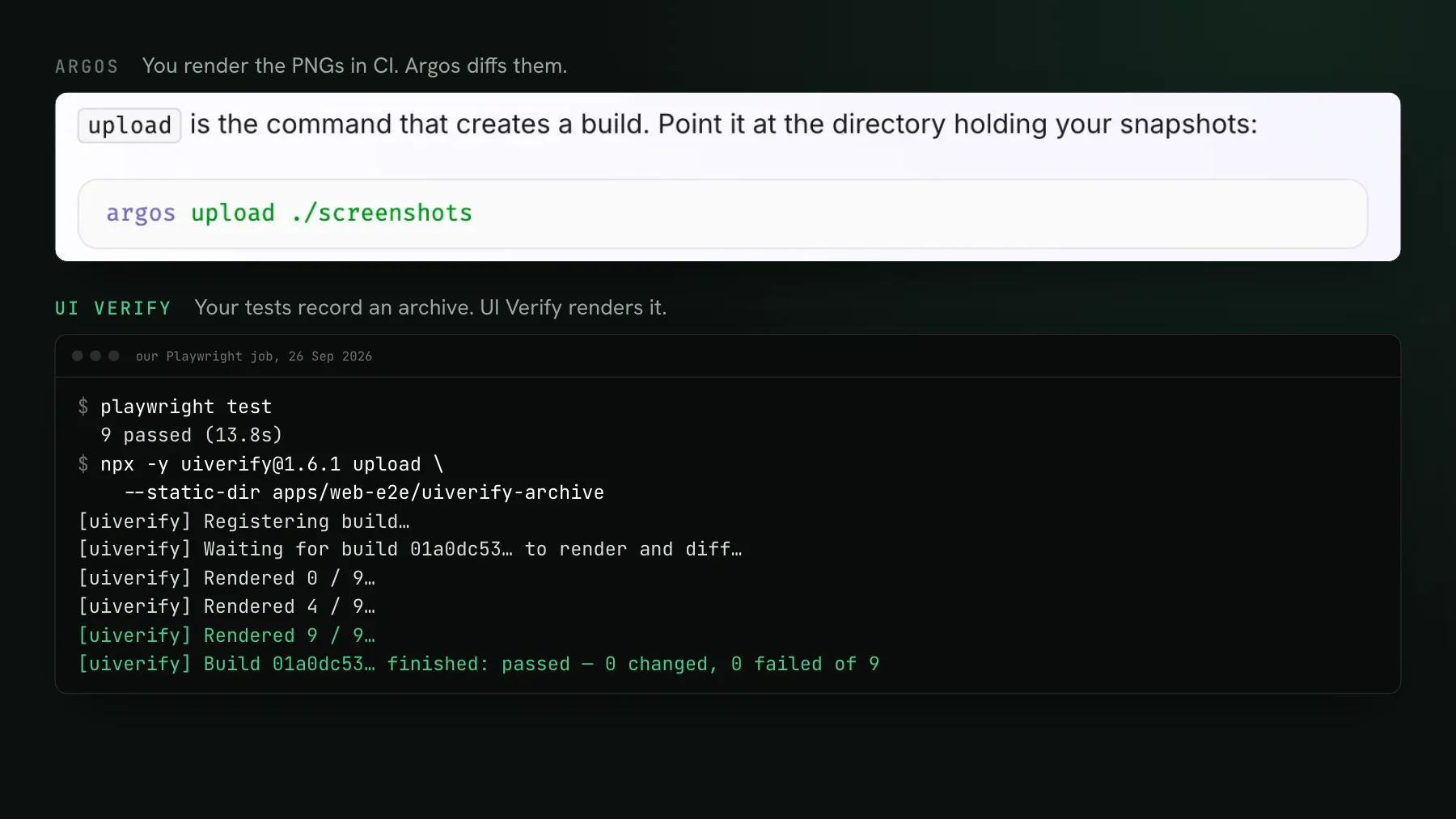
On this page
- Why teams look for an Argos alternative
- What to look for in an Argos alternative
- The best Argos alternatives in 2026
- 1. UI Verify: best for agent-written pull requests
- 2. Chromatic: best for accessibility and Microsoft Edge
- 3. Percy: best for BrowserStack and device-cloud teams
- 4. Applitools: best for enterprise cross-browser Visual AI
- 5. Playwright screenshots: best free, local option
- Argos alternatives compared
- When Argos is still the right choice
- What is the best Argos alternative?
Argos is a lean, open-core visual testing service, and for teams that are happy capturing their own screenshots it is a good, cheap option. But it is worth understanding what Argos does and does not do before you commit: it diffs the screenshots your CI captures and uploads, it renders nothing server-side, and after the diff it hands the decision back to you. This is a roundup of the real Argos alternatives in 2026, what each is good at, and when Argos is still the right pick.
Why teams look for an Argos alternative
The defining fact about Argos is that it captures nothing. Your CI renders the screenshots, in a real browser, and uploads finished PNGs, and Argos diffs, hosts, and reviews them. That is why it looks cheap per screenshot: you are paying for a diff of an image you already rendered, not for the render. The flip side is that everything hard about rendering is yours to own: the cross-machine determinism, the flake control, the environment setup, and keeping it all working as your app changes. The second reason teams move is the same as with any diff tool: Argos ships an MCP and agent triage, but the review still centers on you working a queue of diffs, and at agent-scale PR volume that queue is the bottleneck.
What to look for in an Argos alternative
- Rendering handled for you, if you would rather not own cross-machine determinism and environment setup in your own CI.
- A verdict, not another diff to triage, telling a regression from an intended change so your queue holds only what needs a human.
- An MCP that pairs each diff with a verdict, so an agent approving from the terminal has a reason to act on, not only the pixels.
- Determinism handled at capture time, since the whole point of leaving self-captured screenshots is to stop babysitting flake.
- A cost model that still makes sense once rendering is included, not just a cheap diff of an image you paid to produce elsewhere.
The best Argos alternatives in 2026
Five alternatives worth weighing. UI Verify leads because it is mine to build; the rest each get a fair case for when they beat it.
1. UI Verify: best for agent-written pull requests
UI Verify renders your screenshots for you and judges them. It captures your existing Storybook stories, Playwright pages, and Vitest components by replaying an archive of the test run in the cloud, then an AI judge labels each change a regression or an intended change with a reason and holds the PR when it flags a regression. Because it renders server-side, the cross-machine determinism that is yours to own on Argos is handled for you.
- Cloud rendering, so you are not owning capture and cross-machine determinism in your own CI.
- An AI judge that decides regression versus intended and holds the PR, so review is a decision, not a wall of diffs. See the AI judge.
- Agent review over MCP that reads the cropped per-story diffs with the judge's verdict on each one, and accepts the intended baselines from the terminal. See triage with your agent.
- Determinism handled for you, not owned in CI: the point of leaving self-captured screenshots is to stop babysitting flake, so UI Verify seeds
Math.random, inlines cross-origin fonts, caches images, cuts the network, and forcesprefers-reduced-motionat capture, then re-renders to drop anything nondeterministic. - Chrome, Firefox, and Safari on the free tier, at desktop and mobile widths.
Agent review over MCP is not ours alone: since July 2026 the Argos MCP server lists builds, opens their screenshot diffs, and approves or rejects them. The difference against Argos is that UI Verify renders and judges, not just diffs: cloud capture with determinism handled, and a judge that blocks the merge and hands your agent a reason next to each diff.
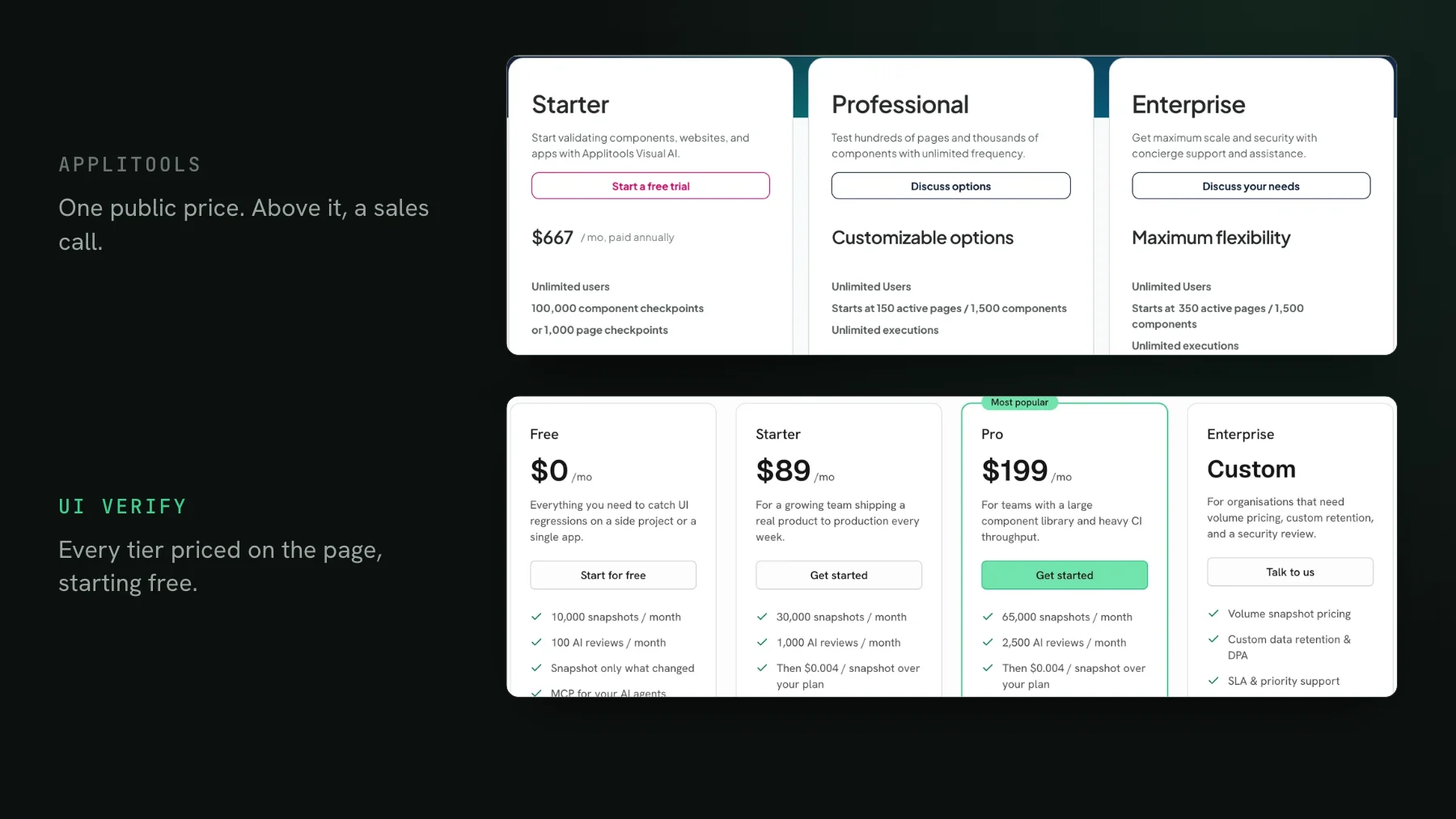
Pricing: free tier of 10,000 snapshots a month, no credit card. Paid plans start at $89 a month for 30,000 snapshots, with $0.004 per snapshot beyond your plan, and that rate includes rendering the screenshot, not just diffing one you produced. Open-source projects get a larger free tier of 50,000 snapshots a month, self-declared at sign-up with no approval and no card (see free for open source). See how that compares at your volume in the pricing calculator.
Best for: teams whose UI is increasingly written and reviewed by coding agents, and anyone who would rather not own rendering and determinism themselves.
2. Chromatic: best for accessibility and Microsoft Edge
Chromatic, from the Storybook team, renders your stories in the cloud too, with hosted baselines, axe accessibility checks in the same run, Microsoft Edge on its paid tiers, and a mature designer-facing UI Review. UI Verify covers Storybook capture, skips unchanged stories the same way, publishes its own permalinked Storybook, and has design review where designers comment and approve or reject, so Chromatic's pull is accessibility and Edge specifically.
Best for: teams that need axe accessibility and Microsoft Edge in the same run. See Chromatic pricing explained.
3. Percy: best for BrowserStack and device-cloud teams
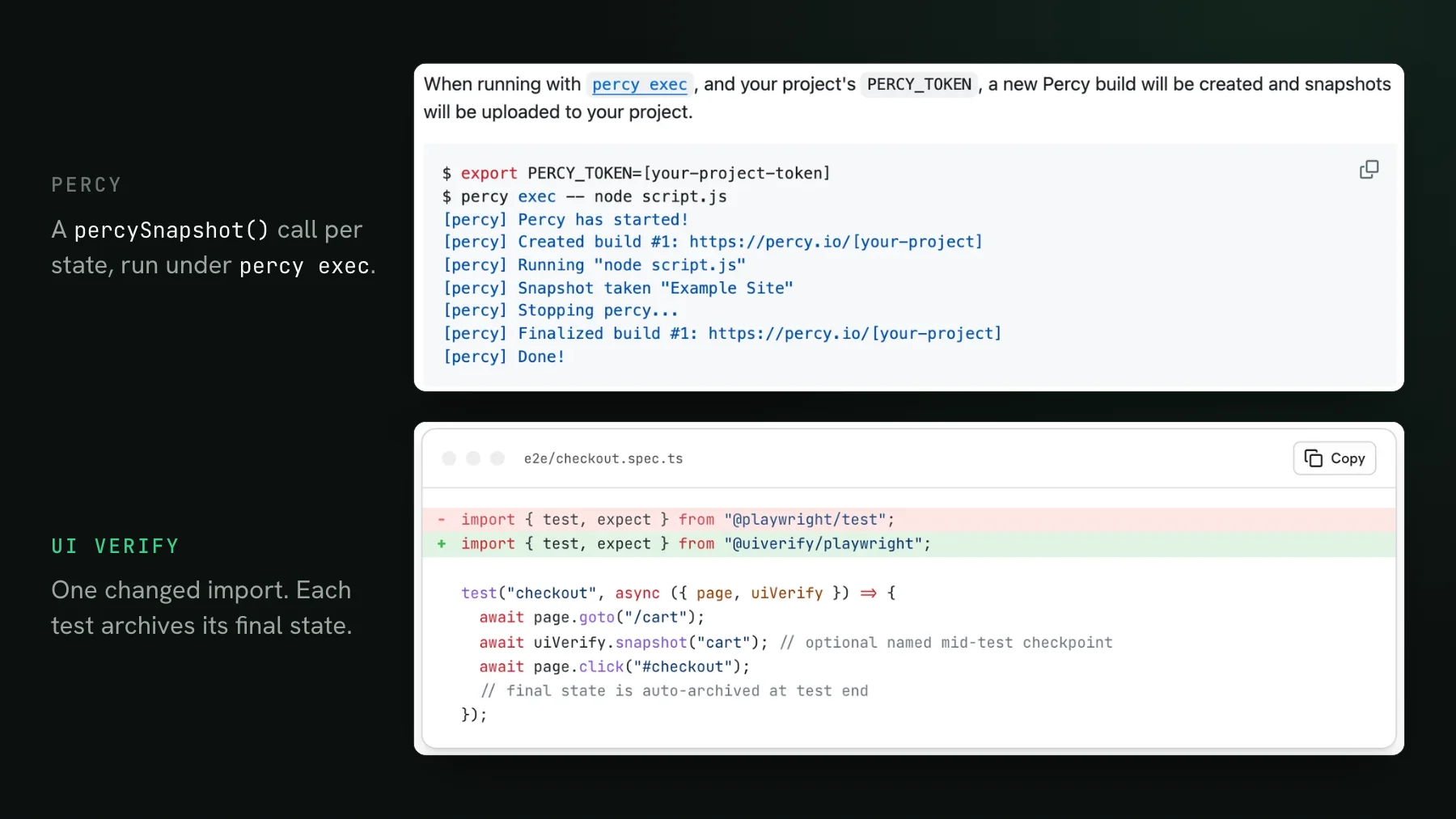
Percy is BrowserStack's visual testing product: hosted baselines, a PR check, a Visual Review Agent that classifies each change, and App Percy for native iOS and Android on BrowserStack's real-device cloud. Like Argos it wires in through SDK calls, but it renders and hosts on the platform side.
Best for: teams already on BrowserStack, or anyone who needs native mobile coverage. See the best Percy alternatives.
4. Applitools: best for enterprise cross-browser Visual AI
Applitools is the enterprise incumbent: perceptual Visual AI with tunable match levels, the Ultrafast Grid for broad cross-browser and device coverage from a single run, and accessibility and design tooling alongside. It is a much heavier, sales-led platform than Argos, aimed at large organizations standardizing on one vendor.
Best for: enterprises standardizing on cross-browser Visual AI. See the best Applitools alternatives.
5. Playwright screenshots: best free, local option
If you already capture in your own CI on Argos, Playwright's built-in toHaveScreenshot diffs those same screenshots locally for free, with mask, threshold, and maxDiffPixelRatio to tame noise. You keep full ownership of capture, and you trade a hosted review UI, history, and judgment for zero dollar cost.
Best for: teams that already diff their own screenshots and want zero cost over a hosted layer.
Argos alternatives compared
| Tool | AI review of changes | Who renders | Free tier | Best for |
|---|---|---|---|---|
| UI Verify | AI judge, regression vs intended, holds the PR | Rendered for you, in the cloud | 10,000 snapshots / mo | Agent-written pull requests |
| Argos | Agent triage over MCP | You render and upload in CI | 5,000 screenshots / mo | Capturing in your own pipeline |
| Chromatic | None for diff triage | Rendered for you, Storybook-first | 5,000, Chrome only | Accessibility and Edge |
| Percy | Visual Review Agent | Rendered on the platform | 5,000 screenshots / mo | BrowserStack and device cloud |
| Applitools | Visual AI, perceptual | Ultrafast Grid renders | ~100 checks / mo | Enterprise cross-browser grid |
| Playwright screenshots | None | You render, local | Free, local | Small suites you review yourself |
When Argos is still the right choice
Argos wins when you already capture screenshots in your own CI and are happy to keep owning that. If your Playwright suite reliably produces deterministic PNGs and you just want a cheap hosted layer to diff, review, and gate them, Argos does exactly that, its open-source roots and low per-screenshot price are real advantages, and there is nothing extra to learn on the capture side. The case for moving is strongest when owning the rendering and the flake control has become the tax you would rather not pay.
What is the best Argos alternative?
It depends on whether you want to keep rendering your own screenshots. If you would rather hand off rendering and get a judged, agent-reviewable check, UI Verify fits best. For a Storybook design system, Chromatic. If you live in BrowserStack or need native mobile, Percy. For enterprise cross-browser Visual AI, Applitools. And if you want to keep capturing yourself for free, Playwright's toHaveScreenshot diffs those screenshots locally.
Leaving Argos? Try UI Verify
UI Verify renders your screenshots for you and an AI judge tells an intended change from a real regression, then holds the PR on a regression so you review decisions, not diffs. It replays your existing tests, so you are not owning the capture and the determinism yourself. Free for 10,000 snapshots a month.
Start for freeNo credit card required.
Set up visual testing
From no visual tests to a green check on every pull request.