Auto-merging agent PRs stops at the UI
Auto-merging agent pull requests works for a dependency bump but stops at the UI. A visual check with an AI verdict lets UI changes join the lane too.
 Igor LuchenkovBuilding UI Verify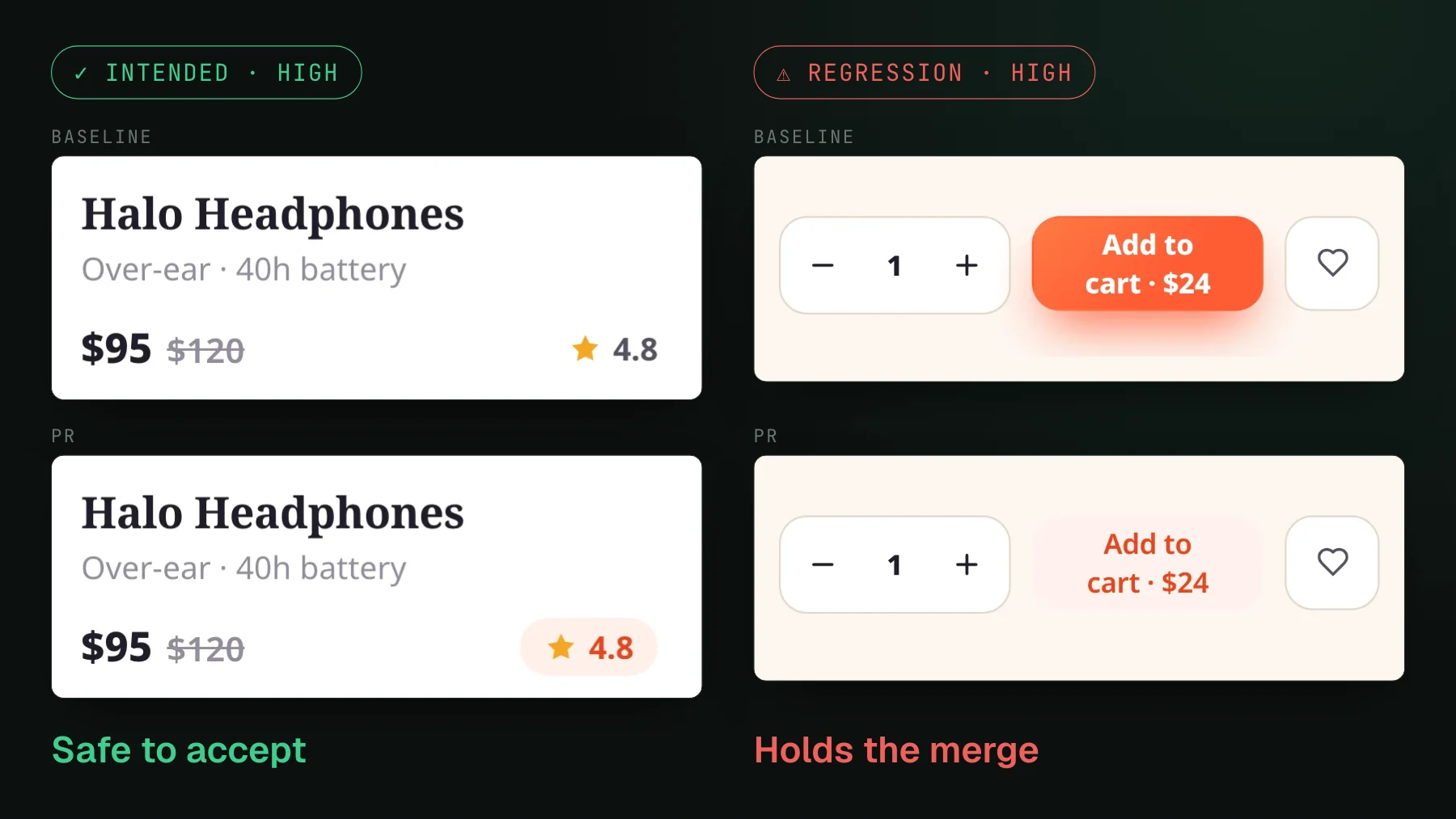
On this page
Some teams now let their agents merge their own pull requests. Not every one, and not blindly - the pattern that keeps showing up is a lane: a class of low-risk change a machine can verify end to end, so it lands without a human in the loop, while everything else still waits for review. A dependency bump is the canonical resident of that lane. This post is about where the lane stops, and it stops at the same place every time: the moment a change touches the UI.
What auto-merging an agent pull request means
Auto-merging an agent pull request is the practice of letting an automated check suite, rather than a human reviewer, decide whether an agent's change is safe to land on the main branch. The change merges the instant every required check passes, with no check that a person still has to read. It works exactly as far as the checks can prove the change correct, which is the whole design and also the whole limitation. A change is safe to auto-merge only when passing the suite is the same statement as being correct.
Why lint and tests settle a dependency bump
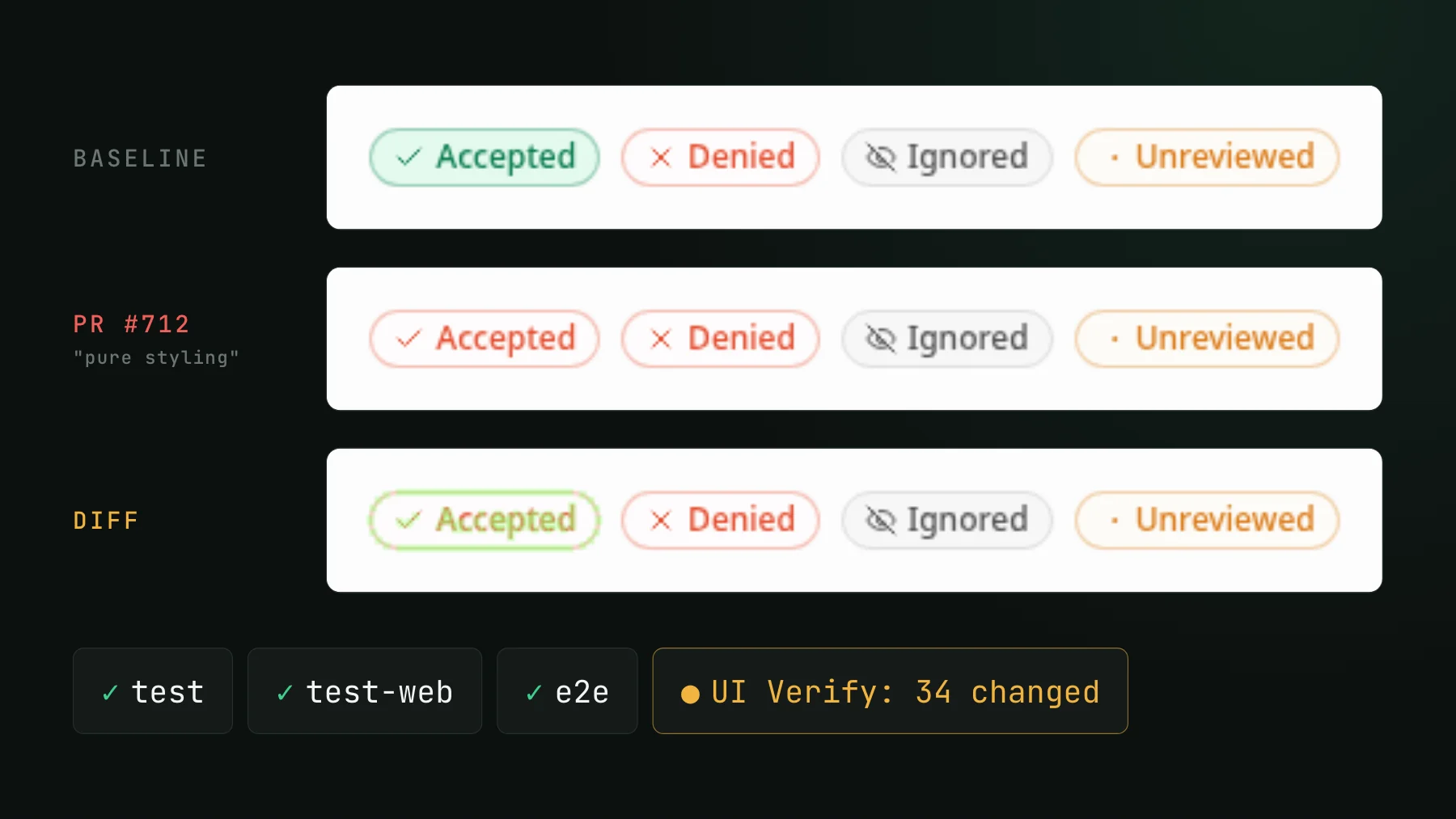
A dependency bump is the cleanest case because it is fully verifiable from the checks you already run. Lint proves the code still parses and conforms, the type checker proves the contracts still hold, and the test suite proves the behavior the tests describe still happens. A patch-level upgrade that keeps every test green has, by construction, not changed anything your suite can observe. There is no rendered surface left to inspect, so there is nothing a human would catch that the machine cannot. Passing equals correct, and the change lands on its own. Our own upgrade of the tar package across this monorepo is that shape: lint, unit, integration and end-to-end jobs green, and all three visual checks reporting no visual changes.
Where auto-merge hard-stops: the UI
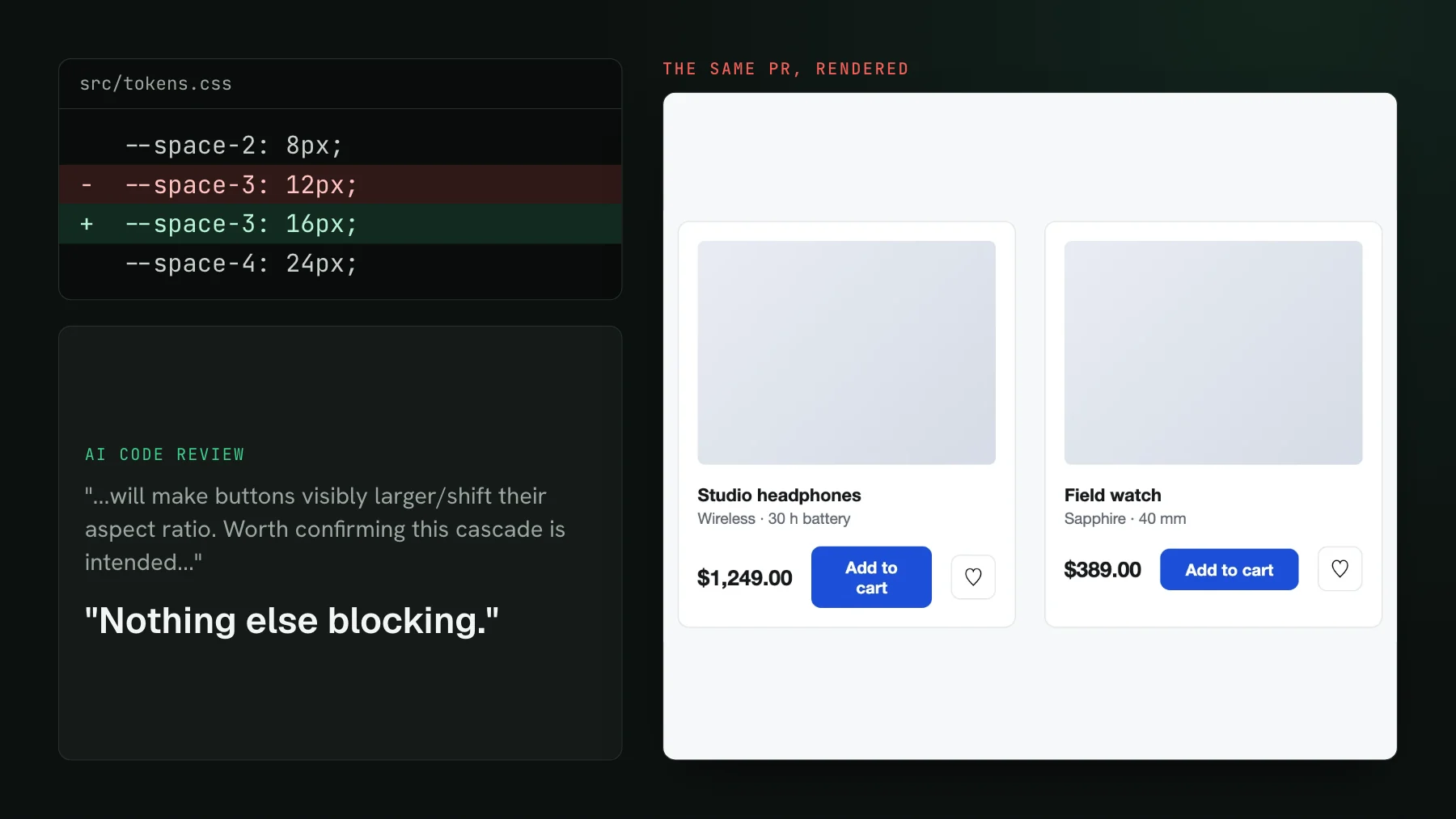
A UI change breaks that equivalence. A passing test suite does not prove the page still looks right, because a layout is spatial and a test asserts behavior. The DOM node is present, the handler fires, the end-to-end flow clicks to the end - and the primary button is still sitting under the header, or pushed off the edge at 375 pixels wide. This is the exact failure mode of agent-built CSS on mobile: green everywhere, broken where nobody looked. The only check that catches it is a rendered screenshot that someone, or something, actually looks at. So the UI change falls out of the auto-merge lane and back onto a human's desk, and the speed advantage evaporates for exactly the changes agents produce most.
What has to be true to auto-merge a UI change safely
Putting a UI change into the auto-merge lane needs three things to be true at once, so that a green result means the same thing a careful reviewer would have concluded:
- A deterministic render. The same commit has to produce the same pixels every time, or the check flakes - and a flaky gate is worse than no gate, because people learn to click past it. That means capturing on a fixed environment with the clock, animations, fonts, and live data neutralized, so a diff means a real change and not a rendering coincidence.
- A trustworthy verdict. A raw pixel diff says something moved, but it cannot say whether it should have. Auto-merge needs a judgment - intended change or regression - reliable enough to act on without a person re-checking it. That is the job of an AI judge, which labels each changed screenshot and holds the pull request when it flags a real regression.
- An escalation path. The lane does not remove the human, it spends the human only where they are needed. When the verdict is a regression, the change has to route to someone - a reviewer, or the agent itself over MCP - to fix or explicitly accept, rather than merging anyway. The clean changes flow through, the flagged ones stop.
The third point is what keeps the lane honest. With the diffs and verdicts available over MCP, the agent can triage its own visual changes - accept the intended restyle it just made, stop on the regression it did not mean to introduce - so the escalation often lands back on the agent before it ever reaches you. A regression still gates the merge either way. Nothing broken is allowed through on the strength of a green suite that could not see it.
The UI joins the auto-merge lane
With those three in place, a UI change is verifiable the way a dependency bump already is: the tool renders it, judges it, and escalates only the ones that are genuinely wrong. The lane stops being everything a machine can prove from lint and tests and becomes everything a machine can prove, screenshots included. That is the unlock - UI changes merge with more scrutiny than before, not less, because the rendered check finally covers the thing the tests never could. For the wider picture of why agents need a rendered check at all, visual testing for coding agents is the companion piece. This one is about the specific workflow it lets you turn on.
Put UI changes in the auto-merge lane
UI Verify renders your UI on every pull request and an AI judge tells an intended change from a real regression - so the low-risk UI changes flow through and only a real regression stops for you. The visual gate that lets agent pull requests merge themselves.
Start for freeNo credit card required.
Triage a build from your agent
Bucket real regressions vs noise and accept baselines, over MCP.